Barcode scanners help businesses capture product information, manage inventory, process transactions, and improve operational accuracy. However, choosing the right scanner involves more than scanning performance alone. Connectivity, mobility, operating environment, and total cost of ownership all influence which device is suitable for a particular application.
When comparing wired vs wireless barcode scanners, businesses should consider where scanning takes place, how frequently employees move between workstations, and whether uninterrupted access to scanned data is essential. A wired scanner may be ideal for a fixed billing counter, while a wireless model can offer greater flexibility in warehouses, distribution centres, and stockrooms.
This guide explains the differences, advantages, limitations, and practical applications of both options to help businesses make an informed purchasing decision.
What Is a Wired Barcode Scanner?
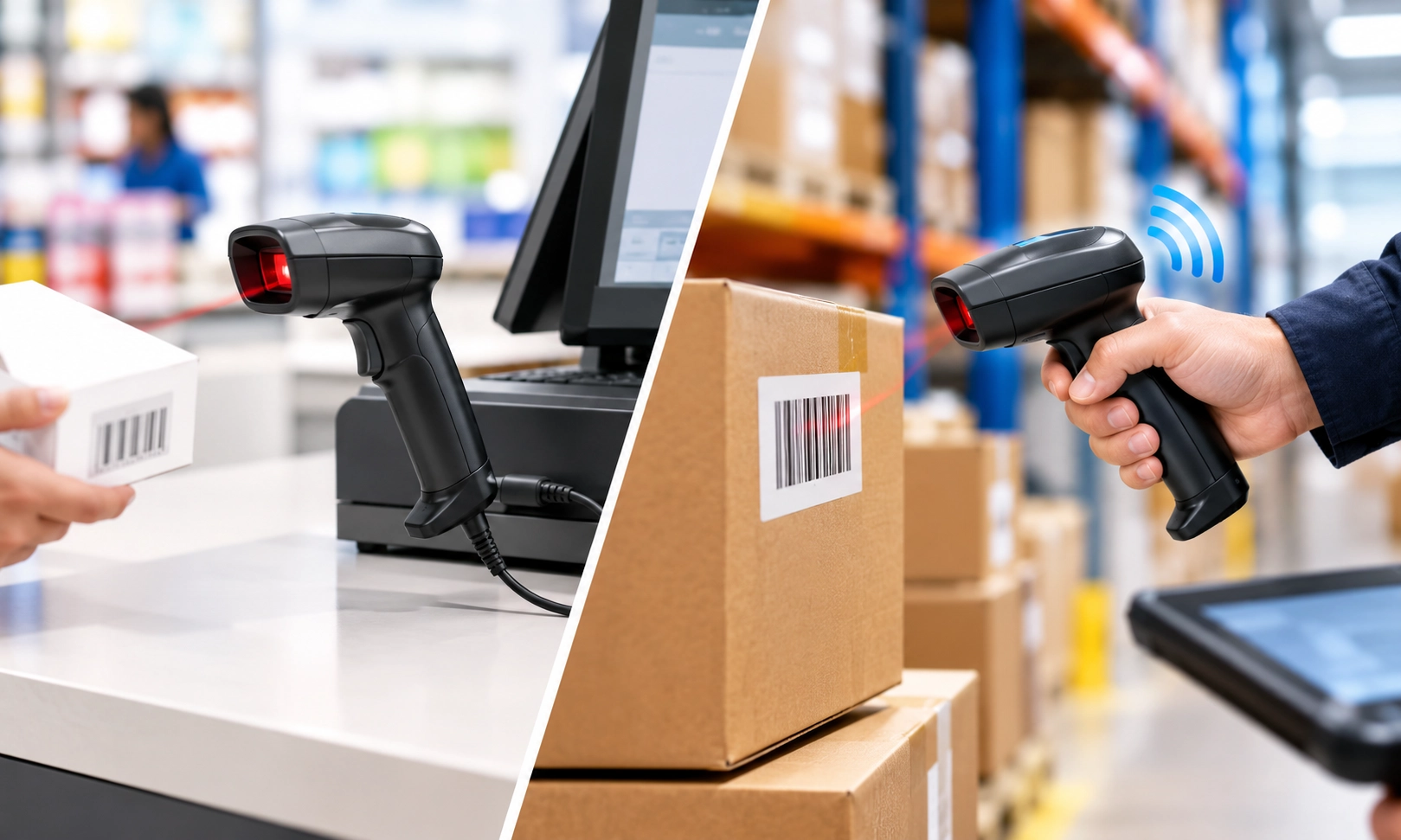
A wired barcode scanner connects to a computer, point-of-sale (POS) terminal, or compatible system through a physical connection, commonly USB. It transfers scanned barcode data directly to the connected device without requiring a separate wireless link.
Key advantages of wired scanners
- Consistent connectivity: A physical connection avoids Bluetooth pairing issues and wireless signal interference.
- No separate battery charging: Most USB-powered models receive power through the connection, depending on the device.
- Simple deployment: Many models support plug-and-play operation with compatible systems.
- Cost-effective operation: Wired models can be economical for fixed scanning stations with high transaction volumes.
Where are wired barcode scanners most useful?
Wired barcode scanners are suitable for retail billing counters, supermarket checkouts, office inventory desks, library systems, and production stations where employees scan items in a defined location.
Their main limitation is restricted movement. Cable length, workstation layout, and cable management can affect convenience when scanning large or bulky items.
What Is a Wireless Barcode Scanner?
A wireless barcode scanner transmits scanned data to a compatible host device without requiring a continuous physical data cable. Depending on the model, connectivity may use Bluetooth or a dedicated wireless connection, such as a 2.4 GHz link through a receiver or base station.
Key advantages of wireless scanners
- Greater mobility: Employees can scan items away from a fixed workstation.
- Flexible workflows: Suitable for stocktaking, order picking, packing, and goods receiving.
- Improved handling convenience: Useful when products are large, heavy, or stored across multiple locations.
- Reduced cable clutter: Helps maintain a more flexible workstation or warehouse layout.
What should businesses consider?
Wireless barcode scanners typically require battery charging and appropriate wireless connectivity. Businesses should evaluate battery runtime, charging arrangements, communication range, pairing requirements, and compatibility with their existing applications.
Wireless performance also depends on the device, environment, obstacles, and connection technology. For larger warehouses, the scanner’s specified range and the actual working conditions should be assessed before purchase.
Find the Right Barcode Scanner for Your Business – Contact Us!
Wired vs wireless barcode scanners: Key differences
The best option depends on how and where your business operates. The following comparison highlights the most important purchasing considerations.
Feature | Wired barcode scanner | Wireless barcode scanner |
Connectivity | Physical cable, commonly USB | Bluetooth or supported wireless connection |
Mobility | Limited by cable length | Greater freedom of movement |
Power | Often supplied through the cable | Usually requires a rechargeable battery |
Setup | Generally straightforward for fixed stations | May require pairing, a receiver, or a base station |
Maintenance | Cable and connector inspection | Battery, charging, and wireless connection management |
Typical deployment | POS counters and fixed workstations | Warehouses, stockrooms, and mobile workflows |
Initial cost | Often lower for comparable basic models | May be higher due to wireless hardware and accessories |
Actual features and costs vary by scanner model, connectivity configuration, and accessories. Always confirm the manufacturer’s specifications before selecting a device.
Which Barcode Scanner Is Best for Different Industries?
Retail and point-of-sale operations
For supermarkets, convenience stores, and retail billing counters, a wired barcode scanner is often a practical choice. It supports frequent scanning at a fixed checkout and avoids the need to manage a separate scanner battery.
Wireless scanners can be more suitable for mobile checkout, price verification, stockroom activities, or situations where employees need to scan products away from the counter.
Warehousing and logistics
Wireless barcode scanners can simplify inventory counting, order picking, packing, and goods-receiving workflows. Employees can scan carton labels and product barcodes while moving through warehouse aisles, provided the device supports the required working range and connectivity.
For stationary packing or dispatch desks, a wired scanner may remain a cost-effective alternative.
Manufacturing and production
Manufacturing facilities use barcode scanning to identify components, track work in progress, record production movements, and verify finished goods.
Wired scanners can suit fixed inspection or assembly stations. Wireless models can support material movement and scanning across different production areas. In demanding environments, businesses should also assess scanner durability, ingress protection, and resistance to accidental drops.
Healthcare and office inventory
Healthcare facilities, laboratories, and office environments may benefit from either configuration. Wired scanners can serve fixed registration and inventory desks, while wireless models offer flexibility when staff must move between shelves, rooms, or storage areas.
The final selection should account for the scanning application, device compatibility, cleaning requirements, and the organisation’s operational procedures.
Upgrade Your Business with Smarter Barcode Scanning Solutions!
Five Factors to Consider Before Buying a Barcode Scanner
Choosing a barcode scanner for business requires evaluating the complete workflow rather than focusing only on the purchase price.
- Barcode type: Determine whether your application requires 1D barcodes, 2D barcodes, QR codes, or other supported symbologies.
- Scanning environment: Consider the working distance, lighting conditions, scan volume, product surfaces, and the need to read damaged or poorly printed labels.
- Connectivity and compatibility: Confirm that the scanner works with your POS software, inventory management system, warehouse management system (WMS), computer, or mobile device.
- Mobility and power: Estimate how far employees travel while scanning, how long devices must operate between charges, and whether charging stations can be provided conveniently.
- Total cost of ownership: Compare the initial device price with accessories, battery replacement, maintenance, training, and the potential impact of scanning interruptions.
A well-matched scanner can support more efficient workflows and reduce unnecessary operational friction.
Barcode Scanner Solutions from Stallion Global
Stallion Global, has been delivering technology solutions to businesses since 1996. Its portfolio spans barcode and RFID solutions, mobile computing, point-of-sale technology, and automation for applications across retail, manufacturing, warehousing, and logistics.
Stallion Global works with established technology partners, including Honeywell and Datalogic, to support business identification and data-capture requirements. Its long-standing Honeywell partnership, established in 2015, reflects its focus on barcode and enterprise technology solutions.
When evaluating wired and wireless scanners, businesses can benefit from selecting equipment based on the application, scanning volume, environment, and existing software infrastructure. Rather than choosing a device solely by price, consider the practical requirements of the employees who will use it every day.
Conclusion: Choose the Right Scanner for Your Workflow
Ultimately, wired vs wireless barcode scanners should be evaluated according to mobility requirements, connectivity, scanning volume, operating environment, and long-term operating costs. Wired models are well suited to fixed workstations, while wireless models provide greater flexibility for mobile inventory and warehouse activities.
Before making a purchase, assess your scanning requirements and confirm compatibility with your existing business systems. Stallion Global can help businesses explore barcode scanning solutions from trusted technology partners and identify suitable options for their operational needs.
Wired or Wireless? Let Our Experts Help You Choose!
Frequently Asked Questions
Are wired barcode scanners more reliable than wireless scanners?
Wired scanners avoid wireless pairing and signal-related issues because they use a physical connection. However, overall reliability depends on device quality, cable condition, configuration, and operating environment. Wireless scanners can perform reliably when correctly configured and used within their supported operating range.
Do wireless barcode scanners need Wi-Fi?
Not necessarily. Many wireless barcode scanners use Bluetooth or a dedicated wireless connection rather than Wi-Fi. The required connectivity depends on the specific scanner and how it communicates with the host system.
Are wireless barcode scanners suitable for warehouses?
Yes. Wireless models are often useful for inventory management, order picking, packing, and receiving because employees can move between locations. Battery runtime, connectivity range, durability, and application compatibility should be checked before deployment.
Which barcode scanner is better for a small business?
A wired scanner can be a practical, economical option for a fixed billing counter. A wireless scanner may be more suitable if employees need to scan items across a store, stockroom, or warehouse. The right choice depends on daily workflow requirements.