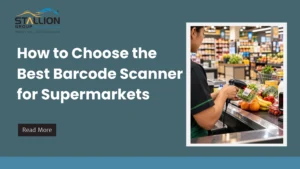
Supermarkets handle thousands of products, transactions, and customer interactions every day. From scanning groceries at checkout to verifying stock in storage areas, barcode technology plays an important role in keeping retail operations accurate and efficient. Choosing the best barcode scanner for supermarkets therefore requires more than looking at scanning speed or price. Businesses should consider barcode compatibility, checkout volume, scanning method, connectivity, POS integration, durability, and the way the scanner will be used.
A suitable retail barcode scanner can help supermarket teams process products quickly, reduce manual data entry, improve billing accuracy, and support better inventory management. This guide explains the key factors supermarkets should evaluate before selecting a barcode scanning solution.
Why Do Supermarkets Need Reliable Barcode Scanners?
Barcode scanners connect physical products with digital information in a Point of Sale (POS) or inventory management system. When a product barcode is scanned, information such as the item number, description, price, and stock status can be retrieved from the connected system.
For supermarkets, this supports several important activities, including:
- Faster checkout and billing
- Accurate product identification
- Inventory and stock management
- Price verification
- Stock receiving and replenishment
- Product returns and exchanges
- Retail analytics and reporting
A scanner that performs consistently during busy periods can also help checkout teams maintain smoother workflows and reduce unnecessary delays.
Find the Right Barcode Scanner for Your Supermarket
What Makes the Best Barcode Scanner for Supermarkets?
There is no single scanner that is ideal for every supermarket. The right choice depends on store size, transaction volume, product types, checkout configuration, and existing POS infrastructure.
When evaluating the best barcode scanner for supermarkets, consider the following factors.
1. 1D and 2D Barcode Support
Traditional retail products commonly use 1D barcodes, while modern retail environments increasingly use 2D codes such as QR codes and other data-rich symbols.
A 2D barcode scanner can read both 1D and 2D codes when supported by the device. This provides flexibility for businesses that may introduce digital coupons, mobile-based codes, loyalty applications, or other 2D-enabled processes.
For supermarkets planning long-term technology investments, checking the scanner’s supported barcode symbologies is an important step.
2. Scanning Speed and Accuracy
Checkout counters may process a high number of products within a short period. A retail barcode scanner should therefore provide responsive scanning and reliable decoding.
Scanning performance can be particularly important during peak shopping periods, weekends, holidays, and promotional campaigns. However, speed should not be evaluated separately from accuracy. A scanner that reads different barcode orientations and commonly encountered product codes reliably can contribute to a smoother billing process.
3. Handheld or Presentation Scanner?
The physical checkout environment should influence the scanner type.
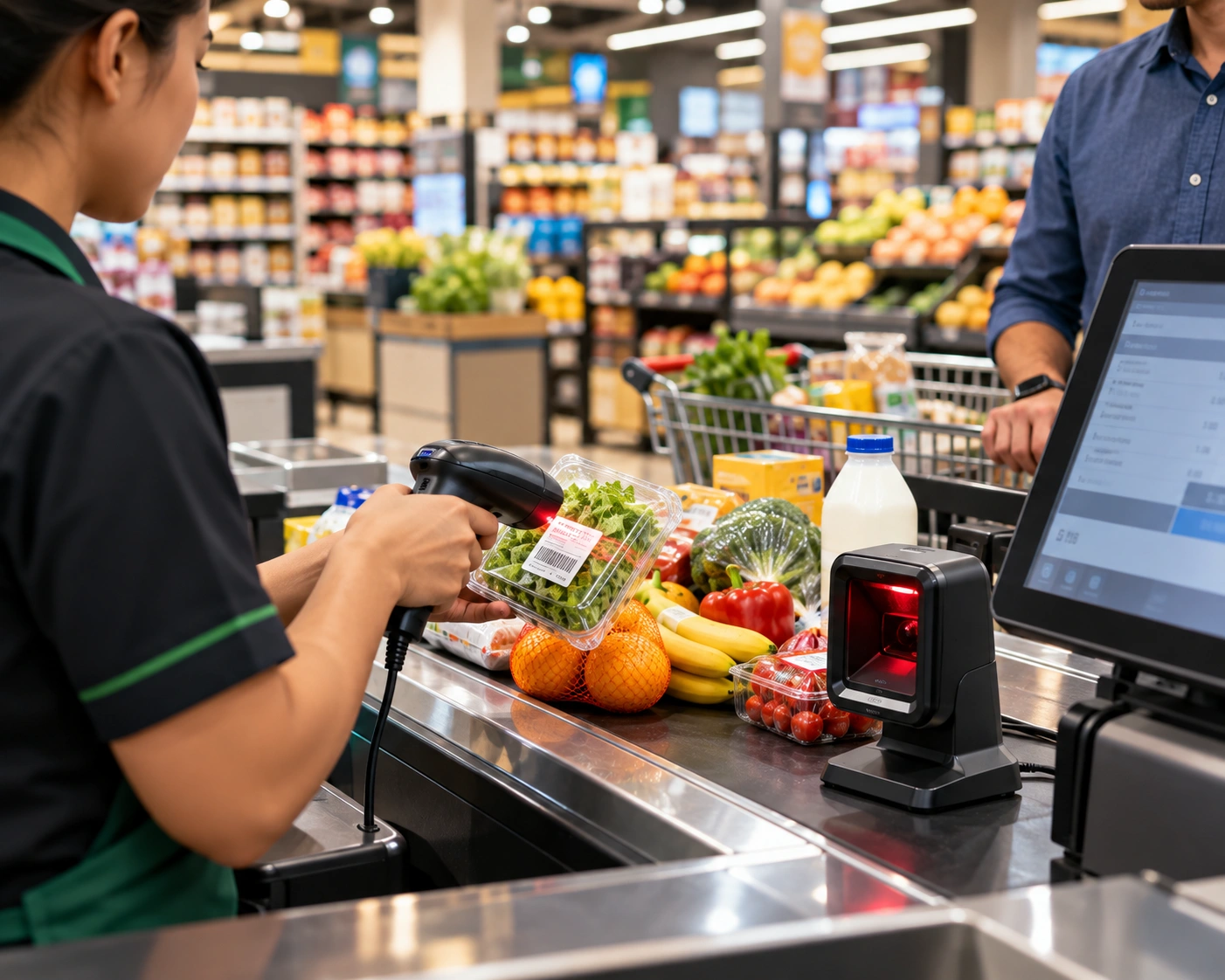
Handheld barcode scanners provide flexibility because the cashier can pick up the device and scan products individually. They can be useful for counters where products vary significantly in size or scanning position.
Presentation barcode scanners are designed for hands-free scanning. The customer or cashier can present a product in front of the scanner, making them suitable for high-volume checkout environments.
For larger supermarkets, businesses may also consider fixed retail scanners or integrated checkout configurations depending on their counter design and POS requirements.
4. POS Compatibility and Connectivity
A scanner is only useful when it communicates reliably with the supermarket’s billing system. Before purchasing a POS barcode scanner, verify compatibility with the existing POS software and hardware.
Common connectivity options include:
- USB
- Bluetooth
- Wireless connectivity
- Serial interfaces, depending on the system
Businesses should also check operating-system compatibility, available drivers, scanner configuration options, and integration requirements.
Stallion Global’s retail solutions integrate barcode scanners with POS systems, inventory management, RFID, mobile computers, and other retail technologies to create a connected retail environment.
Choose the Right Barcode Scanner for Your Retail Business
1D vs 2D Barcode Scanners for Supermarkets
One of the most common questions when purchasing a scanner is whether a supermarket should choose a 1D or 2D model.
1D scanners are suitable when the business primarily works with traditional linear product barcodes.
2D scanners use imaging technology to capture two-dimensional codes and can also support many conventional 1D barcodes. They can therefore provide greater flexibility for supermarkets adopting newer digital retail applications.
The right choice depends on the supermarket’s current barcode environment and future requirements rather than simply choosing the newest technology.
What About Wireless Barcode Scanners?
Wireless barcode scanners can provide greater freedom of movement around a checkout or retail environment. They can be useful for scanning large or heavy products that cannot easily be placed directly in front of a fixed scanner.
However, businesses should evaluate battery life, charging arrangements, wireless range, connectivity reliability, security, and the number of scanners required before selecting a cordless solution.
For inventory activities away from the billing counter, mobile computers can also complement handheld scanners by supporting stock verification, receiving, cycle counting, and product movement.
Choosing a Scanner for Billing and Inventory
Supermarkets should consider whether the scanner will be used only for checkout or across multiple workflows.
For supermarket billing, important considerations include scanning speed, hands-free operation, barcode compatibility, ergonomics, and POS integration.
For inventory management, mobility, wireless connectivity, scanning range, durability, and compatibility with inventory software become more important.
A supermarket with multiple operational requirements may benefit from using different scanner formats across checkout counters, receiving areas, stockrooms, and inventory teams.
Barcode Scanner Brands and Retail Technology
The market includes established barcode technology manufacturers such as Honeywell, Datalogic, Zebra Technologies, Newland, SEUIC and BOXP. Each manufacturer offers different scanner categories and configurations for retail, logistics, warehouse, and other applications.
Stallion Global‘s current portfolio includes barcode scanning products from brands such as Honeywell and Datalogic, alongside mobile computing and retail technologies. Its product resources also list handheld, presentation, and imaging scanner categories.
The right brand or model should ultimately be selected according to the supermarket’s workflow, POS environment, barcode requirements, operating conditions, and support expectations.
Common Mistakes When Choosing a Supermarket Barcode Scanner
Businesses can avoid unnecessary costs by assessing their actual workflow before purchasing equipment.
Common mistakes include:
- Choosing based only on purchase price
- Ignoring POS compatibility
- Selecting a scanner without checking barcode requirements
- Buying a handheld model when hands-free scanning is needed
- Overlooking connectivity requirements
- Not considering peak checkout volumes
- Failing to evaluate after-sales support
- Selecting equipment without testing it in the actual retail environment
A practical evaluation should include product samples, barcode types, checkout conditions, software compatibility, and the expected number of scans.
Why Choose Stallion Global for Retail Barcode Solutions?
Stallion Global has been delivering barcode, RFID, POS, automation, and AIDC solutions since 1996, with operations serving businesses across India and the Middle East. Its retail offering combines barcode scanners, POS systems, inventory management, RFID, mobile computing, and related technologies.
The company provides retail automation solutions for supermarkets, hypermarkets, grocery stores, pharmacies, electronics retailers, and other retail businesses. Its approach includes consultation, solution design, implementation, training, technical support, and after-sales service.
For businesses in Kochi, Kerala, and across India, this combination of technology expertise and local support can be useful when selecting and deploying retail barcode equipment. Stallion Global also supports businesses across the UAE, Oman, and Qatar.
Find the Right Retail Barcode Scanning Solution
The best barcode scanner for supermarkets is not necessarily the fastest or most expensive model. It is the scanner that matches the store’s checkout workflow, barcode requirements, POS environment, and operational needs.
Whether you need handheld barcode scanners for flexible retail operations, presentation scanners for high-volume checkout, or integrated barcode and POS solutions, Stallion Global can help evaluate the technology requirements and build a solution around your business workflow.
Talk to Our Retail Experts About Your Scanning Needs
Frequently Asked Questions
What type of barcode scanner is best for supermarkets?
The best barcode scanner for supermarkets depends on checkout volume, barcode types, POS compatibility, and the intended application. Presentation scanners can suit high-volume checkout, while handheld models provide greater flexibility.
Is a 2D barcode scanner better for supermarket billing?
A 2D scanner can provide broader barcode support, including many 1D and 2D codes. It can be useful for supermarkets that need to scan QR codes or plan to adopt newer 2D-based applications.
Should supermarkets use handheld or presentation scanners?
Handheld scanners provide flexibility, while presentation scanners support hands-free operation. The choice should depend on checkout design, product mix, transaction volume, and cashier workflow.
Can barcode scanners integrate with POS systems?
Yes. Many retail barcode scanners are designed to communicate with POS systems through interfaces such as USB, Bluetooth, or other supported connections. Compatibility should be confirmed before purchase.