Managing inventory across retail stores, warehouses, and distribution centres requires accurate information, coordinated operations, and timely decisions. Yet many businesses still depend on manual stock entries, spreadsheets, and periodic physical checks, creating opportunities for inventory discrepancies, delayed fulfilment, and unnecessary operating costs.
Inventory Management Automation addresses these challenges by connecting barcode scanning, RFID technology, mobile computing, and inventory software into streamlined workflows. Instead of waiting for manual stock updates, businesses can capture inventory movements as they happen and make reliable information available across departments.
For retailers and logistics providers, automation is not simply about replacing paperwork. It creates a stronger foundation for inventory accuracy, operational efficiency, and sustainable business growth.
What Is Inventory Management Automation?
Inventory Management Automation is the use of connected technologies and software to record, monitor, and control inventory activities with reduced manual intervention.
An automated inventory system typically combines Automatic Identification and Data Capture (AIDC) technologies with a Warehouse Management System (WMS), Enterprise Resource Planning (ERP) platform, or inventory management software.
For example, when a warehouse employee scans an incoming product barcode, the system can identify its Stock Keeping Unit (SKU), record the received quantity, and update the relevant inventory database.
Depending on the integration, the same information can become available to purchasing, warehouse, and sales teams without duplicate data entry.
This approach helps businesses maintain accurate records while improving the speed and consistency of everyday operations.
Why Traditional Inventory Management Creates Operational Challenges
Manual inventory processes become increasingly difficult as businesses expand their product ranges, warehouse locations, and transaction volumes.
Common challenges include:
- Inventory discrepancies: Manual entries can create differences between physical stock and recorded quantities.
- Limited stock visibility: Disconnected systems make it difficult to track inventory across multiple locations.
- Stockouts and overstocking: Delayed information can affect purchasing and replenishment decisions.
- Time-consuming audits: Physical stock verification requires considerable employee effort.
- Fulfilment errors: Incorrect picking or dispatch records can lead to shipment delays and customer dissatisfaction.
These challenges demonstrate why businesses need reliable inventory data rather than simply faster stock-counting procedures.
Transform Your Inventory with Smarter Automation
How Automation Improves Inventory Visibility and Accuracy
1. Real-Time Inventory Tracking with Barcode Technology
Barcode-based inventory management enables businesses to capture product information during receiving, storage, picking, and dispatch.
Each scan creates a digital transaction that can update the connected inventory system. This reduces reliance on handwritten records and helps employees identify products more accurately.
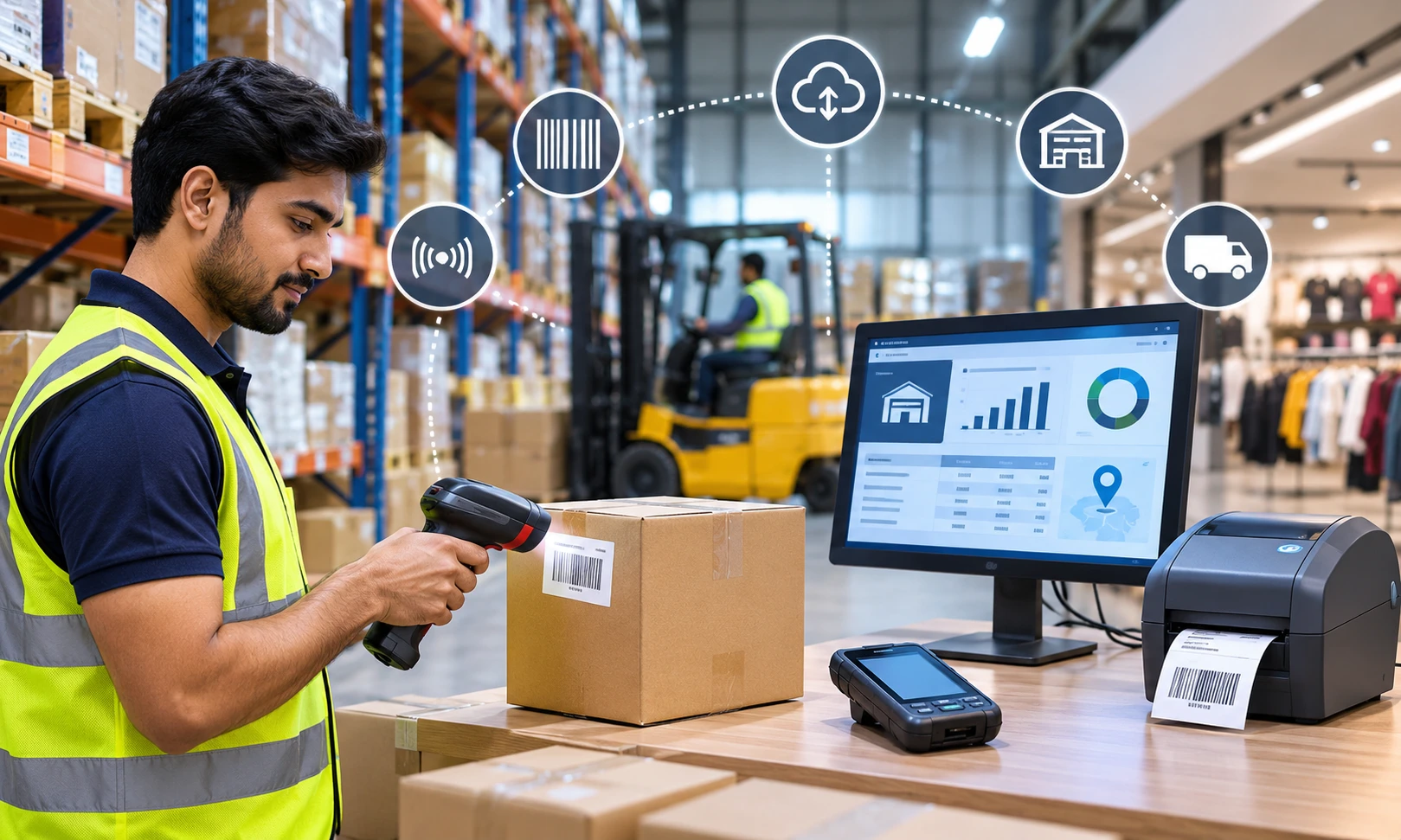
Barcode scanners, industrial label printers, and handheld mobile computers support these workflows across retail counters, warehouses, and logistics facilities.
When properly integrated, real-time inventory tracking gives managers clearer visibility into stock quantities, product locations, and inventory movements.
2. RFID for Faster Inventory Identification
Radio Frequency Identification (RFID) provides another approach to automated inventory tracking.
Unlike conventional barcode scanning, which generally requires optical visibility of a code, RFID uses radio waves to identify compatible tagged items.
In suitable environments, RFID readers can capture information from multiple tags without individually scanning each label.
This capability can support faster stock verification, asset identification, and inventory movement tracking.
However, RFID performance depends on factors such as tag selection, reader configuration, surrounding materials, and the operating environment. Businesses should evaluate these requirements before implementation.
3. Integration with ERP, WMS, and POS Systems
Inventory automation becomes more valuable when data flows between operational systems.
A Warehouse Management System (WMS) can coordinate receiving, put-away, picking, and dispatch activities, while Enterprise Resource Planning (ERP) software connects inventory information with purchasing and other business functions.
In retail environments, Point of Sale (POS) integration can help update stock records as products are sold.
These integrations reduce disconnected data records and help departments work with more consistent information.
Automated Replenishment and Smarter Demand Planning
Inventory Management Automation can also improve how businesses plan purchasing and stock replenishment.
Instead of depending entirely on fixed ordering schedules, inventory software can monitor minimum stock levels, sales velocity, supplier lead times, and reorder points.
When stock reaches a predefined threshold, the system can generate an alert or initiate a replenishment workflow, depending on its configuration.
Advanced solutions may also use artificial intelligence (AI), machine learning, and historical sales patterns to support demand forecasting.
For example, a retailer preparing for seasonal demand can analyse previous sales, promotional activity, and current inventory availability to make better purchasing decisions.
The objective is to maintain sufficient stock without unnecessarily increasing storage costs or tying up working capital.
Unlock Smarter Inventory Management Solutions
Improving Warehouse Efficiency Through Automated Workflows
Warehouse inventory automation supports operational consistency from goods receiving to final dispatch.
Consider a typical barcode-enabled warehouse workflow:
- Receiving: Employees scan incoming products and verify quantities against purchase orders.
- Put-away: The system records the storage location assigned to each item.
- Picking: Handheld mobile computers guide employees through order fulfilment tasks.
- Packing: Barcode verification helps confirm that the correct products have been selected.
- Dispatch: Shipment details are recorded and updated in the connected system.
This structured process reduces repeated data entry and supports more accurate order processing.
Automation also creates useful operational data, allowing warehouse managers to identify recurring errors, review processing times, and improve resource allocation.
The Role of AI and IoT in Modern Inventory Operations
Artificial intelligence and the Internet of Things (IoT) are expanding the possibilities of inventory optimization.
AI-enabled analytics can help businesses identify slow-moving inventory, forecast demand, and evaluate replenishment patterns.
IoT-connected devices may provide additional information about equipment status, storage conditions, or product movement.
For temperature-sensitive products, connected sensors can support environmental monitoring throughout storage and transportation.
However, these capabilities depend on the technologies deployed and the quality of available data. Effective automation begins with accurate identification, dependable data capture, and well-integrated business systems.
Why Choose Stallion Global for Inventory Automation?
Selecting the right automation partner requires more than choosing individual devices. Businesses need technologies that suit their operating environment, existing software, and future expansion plans.
Established in 1996, Stallion Global brings decades of industry experience in Automatic Identification and Data Capture (AIDC) and business automation technologies.
As a Honeywell Diamond Partner, Stallion Global works within an established technology ecosystem that supports enterprise identification and data-capture requirements.
Its solution portfolio includes barcode scanners, barcode printers, RFID technologies, mobile computers, and software solutions for business operations.
With a presence across India, the UAE, Qatar, and Oman, Stallion Global serves organisations operating in different business environments.
The company’s hardware and software expertise helps businesses explore practical solutions for inventory identification, data capture, and system integration.
Rather than treating every warehouse or retail operation identically, an effective implementation should consider transaction volumes, barcode requirements, connectivity, existing ERP or WMS platforms, and employee workflows.
This requirements-led approach helps organisations select suitable technologies and plan automation with minimal disruption.
Conclusion: Building Smarter Inventory Operations
Inventory Management Automation helps retail and logistics businesses move from disconnected manual processes towards accurate, connected, and data-driven operations.
Barcode technology, RFID, mobile computing, and integrated inventory software create opportunities to improve stock visibility, streamline fulfilment, and strengthen operational control.
For businesses planning to modernise their inventory processes, the right combination of technology and implementation expertise is essential.
Simplify Inventory Management with Stallion Global
Frequently Asked Questions
Is RFID better than barcode scanning for inventory management?
Neither technology is universally better. Barcode scanning is widely used for cost-effective product identification, while RFID can support non-line-of-sight identification and multiple-tag reading. The right choice depends on business requirements.
Can inventory automation integrate with existing ERP software?
Yes. Many inventory automation solutions can connect with ERP, WMS, and POS platforms through supported interfaces or integration services. Compatibility should be assessed before deployment.
Can small retail businesses benefit from automation?
Yes. Small businesses can begin with barcode labels, scanners, and inventory software, then expand their systems as transaction volumes and operational requirements increase.
What are the main benefits of inventory automation?
Automated inventory management can improve stock accuracy, reduce manual data entry, increase inventory visibility, and support faster warehouse operations. Results depend on system configuration, integration, and operational practices.