Accurate product identification and data collection are essential for businesses managing inventory, shipments and daily operations. From retail checkout counters to large manufacturing facilities, organizations need reliable ways to capture product information, monitor stock movements and reduce manual errors. Barcode scanning technology provides an effective way to automate these activities and improve operational efficiency.
By converting printed barcode information into digital data, businesses can identify products, update inventory records and track goods throughout their operations. Modern barcode scanners also integrate with software platforms such as Warehouse Management Systems (WMS), Enterprise Resource Planning (ERP) and Point of Sale (POS) systems.
For organizations looking to improve productivity and supply chain visibility, choosing the right barcode scanning solution is an important step towards automation.
What Is Barcode Scanning Technology and How Does It Work?
Barcode scanning technology uses optical devices to read machine-readable codes printed on products, packaging, labels and assets. These codes contain information such as product identification numbers, serial numbers and other relevant data.
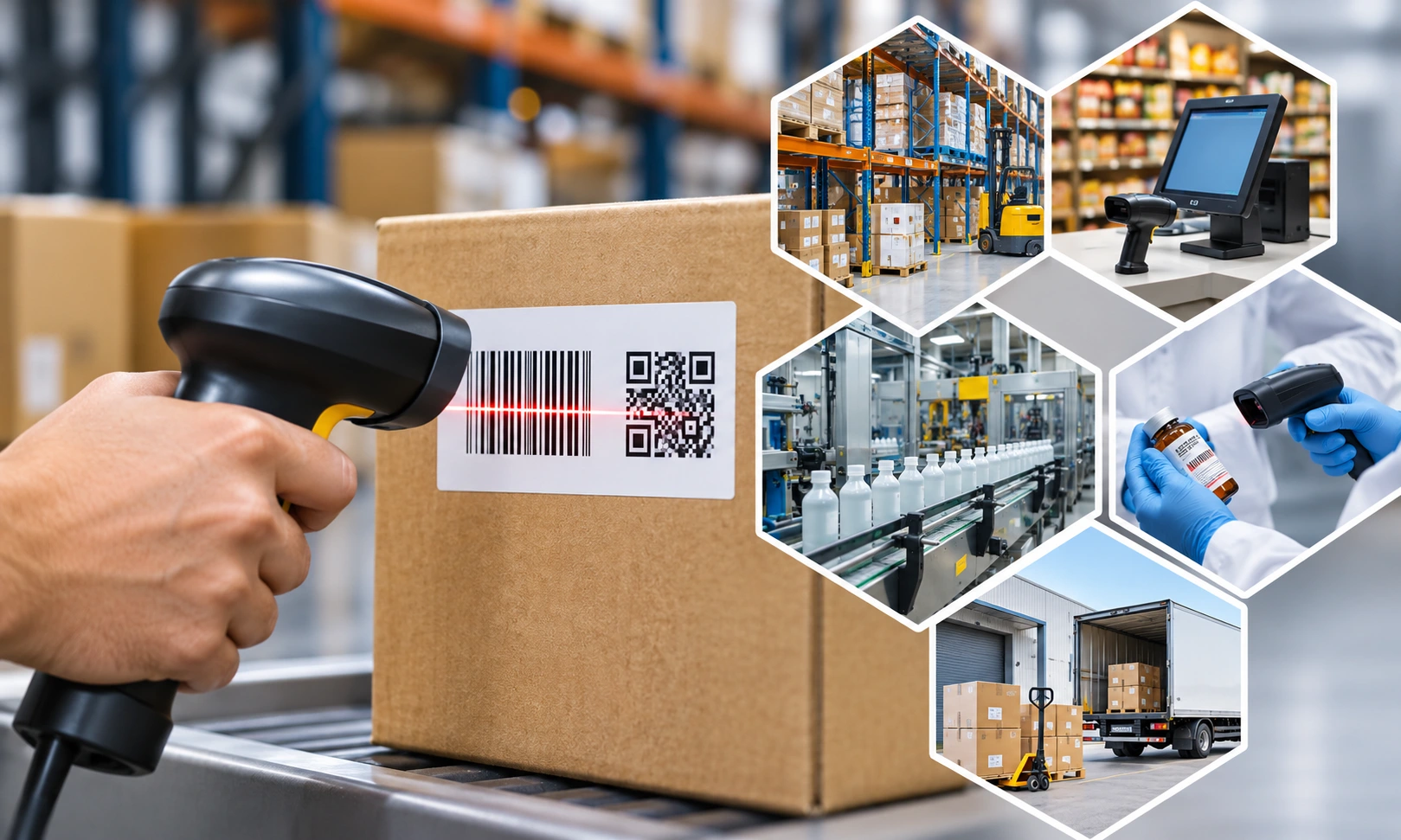
A barcode scanner captures the pattern using a light source and optical sensor or an imaging camera, depending on the scanner type. The decoded information is then transmitted to connected software for processing.
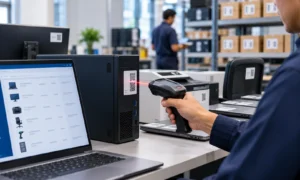
For example, when a warehouse employee scans a product barcode, the connected inventory system can identify the item and record its movement. This reduces manual data entry and improves inventory accuracy.
Upgrade Your Business with Smart Barcode Solutions!
What Are the Different Types of Barcodes?
Barcodes are generally classified into two categories based on how information is encoded.
1. Linear (1D) Barcodes
One-dimensional barcodes represent information using parallel lines and spaces of varying widths. They are commonly used in retail products, packaging, shipping labels and inventory identification.
Popular examples include:
- UPC: Commonly used for product identification in retail.
- EAN: Widely used for identifying consumer products internationally.
- Code 128: Used for logistics, shipping and inventory applications.
2. Two-Dimensional (2D) Barcodes
Two-dimensional barcodes store information horizontally and vertically, allowing them to hold more data than traditional linear barcodes.
Common examples include:
- QR Codes: Used for product information, digital payments and customer interactions.
- Data Matrix: Commonly used in manufacturing, healthcare and pharmaceutical product identification.
Businesses should select barcode formats according to their identification, traceability and data management requirements.
Types of Barcode Scanners Used in Industries
Different scanning devices are designed for specific working environments and operational requirements.
Handheld Barcode Scanners: These portable devices are widely used in retail stores, warehouses and distribution centres. They allow employees to scan products, cartons and inventory labels conveniently.
Wireless Barcode Scanners: Bluetooth and other wireless scanners provide greater mobility by allowing employees to move around without being restricted by cables. They are useful for warehouse inventory checks and stock management.
Fixed-Mount Barcode Scanners: Installed on conveyors, production lines and automated systems, fixed barcode scanners capture product information as items move through designated scanning points.
Industrial Barcode Scanners: Designed for demanding environments, these scanners offer durability and reliable performance in manufacturing, logistics and warehouse operations.
Mobile Computers and PDA Devices: These devices combine computing capabilities with barcode scanning, enabling employees to collect, process and transmit information while working across different locations.
Key Applications of Barcode Scanning in Business Operations
Barcode scanners support a wide range of business processes by improving identification, tracking and data collection.
Retail and POS Operations
Retail businesses use barcode scanners to identify products, retrieve pricing information and process customer transactions. Integration with POS software also helps update inventory records following sales.
Warehouse Management
Barcode scanning simplifies receiving, put-away, picking, packing and dispatch activities. Employees can scan product labels and storage locations to maintain accurate stock records and reduce fulfilment errors.
Manufacturing and Production
Manufacturers use barcode identification to track raw materials, work-in-progress items and finished products. Scanning at different production stages improves traceability and supports production monitoring.
Healthcare and Pharmaceuticals
Healthcare organizations use barcode scanning for patient identification, medication verification, laboratory sample tracking and medical inventory management. These applications help improve identification accuracy and support safer workflows.
Logistics and Supply Chain Management
Logistics companies use barcode labels to identify shipments, record package movements and verify deliveries. This improves shipment visibility and supports efficient transportation and distribution operations.
Asset Management
Barcode-based asset tracking helps organizations identify equipment, maintain asset records and monitor asset allocation. It supports better utilization and simplifies periodic asset audits.
Improve Accuracy with Advanced Barcode Scanning!
Barcode vs RFID: Which Technology Should Businesses Choose?
Both barcode and Radio Frequency Identification (RFID) technologies support automatic identification and data capture, but they work differently.
|
Feature |
Barcode |
RFID |
|
Identification method |
Optical scanning |
Radio frequency |
|
Line of sight |
Generally required |
Not required |
|
Multiple item reading |
Usually individual scanning |
Multiple tags can be read together |
|
Data storage |
Limited, format-dependent |
Depends on tag type and capacity |
|
Infrastructure |
Scanners and printed labels |
Readers, antennas and RFID tags |
|
Common applications |
Retail, inventory and shipping |
Warehousing, asset tracking and automation |
Barcode technology is often suitable for cost-effective product identification and structured scanning workflows. RFID is useful when businesses require automated identification, bulk reading or reduced manual scanning.
Organizations can also combine barcode and RFID solutions to improve visibility across different operational processes.
How to Choose the Right Barcode Scanner for Your Business
Selecting a barcode scanner requires evaluating the environment in which it will operate and the tasks it needs to perform.
Consider these important factors:
- Barcode Compatibility: Determine whether your business needs 1D, 2D or both barcode scanning capabilities.
- Scanning Distance: Choose a device based on whether employees need short-range or long-range scanning.
- Operating Environment: Consider durability, dust exposure, temperature and working conditions, especially in industrial environments.
- Connectivity: Evaluate USB, Bluetooth, Wi-Fi or other connectivity requirements.
- Scanning Frequency: High-volume operations may require devices designed for continuous scanning.
- Software Compatibility: Ensure the scanner integrates with your existing POS, WMS or ERP applications.
- Ergonomics and Battery Life: For mobile operations, consider device weight, handling comfort and battery performance.
Choosing a compatible device helps businesses avoid unnecessary costs and establish a reliable data capture process.
How Stallion Global Supports Barcode and AIDC Solutions
With over 30 years of experience in technology solutions, Stallion Global provides barcode, RFID and Automatic Identification and Data Capture (AIDC) solutions for businesses across India and the Middle East.
As a Honeywell Diamond Partner in India, Stallion Global works with leading technology brands, including Honeywell, Datalogic, Seuic and Sunmi, to support different business identification and data capture requirements.
Its technology portfolio includes:
- Handheld Barcode Scanners: For retail billing, inventory management and warehouse operations.
- Fixed Barcode Scanners: For automated product identification and production line applications.
- Mobile Computers: For mobile data collection and warehouse activities.
- Barcode Printers: For printing product labels, shipping labels and identification tags.
- RFID Solutions: For automated identification, inventory visibility and asset tracking.
By combining suitable hardware with business software and integration capabilities, Stallion Global helps organizations develop solutions that align with their operational requirements.
Find the Right Barcode Scanner for Your Business!
Frequently Asked Questions
Which barcode scanner is best for warehouse operations?
Handheld wireless scanners and industrial barcode scanners are commonly used in warehouses. The appropriate choice depends on scanning distance, working environment, barcode type and daily scanning volume.
Can barcode scanners work with inventory management software?
Yes. Compatible barcode scanners can connect with inventory management software, WMS and ERP platforms to capture product information and update inventory transactions.
What is the difference between 1D and 2D barcode scanners?
A 1D scanner reads traditional linear barcodes, while a 2D imaging scanner can read both linear and two-dimensional codes such as QR Codes and Data Matrix, depending on the model.
Can barcode and RFID technologies work together?
Yes. Businesses can use barcode scanners for individual product identification and RFID readers for automated tag detection. Combining both technologies can support different tracking and inventory requirements.