
Manufacturers need reliable ways to identify components, track production, and maintain product traceability throughout the supply chain. Traditional barcode labels work well for many applications, but they may not be suitable for components exposed to heat, abrasion, chemicals, or repeated handling. In these situations, permanent identification methods can offer a practical alternative.
Direct Part Marking (DPM) creates an identification code directly on a component’s surface, helping manufacturers retain important product information without depending on a separate label. When combined with compatible barcode scanners and traceability software, this technology can support quality control, production tracking, and accurate component identification.
For automotive, electronics, aerospace, medical device, and industrial manufacturing businesses, understanding this technology can help improve identification processes and strengthen operational visibility.
What Is Direct Part Marking in Manufacturing?
Direct Part Marking is a method of applying an identification symbol or code directly to a component, part, or product surface. Unlike conventional barcode labels, the mark is applied to the component itself rather than printed on a separate adhesive label.
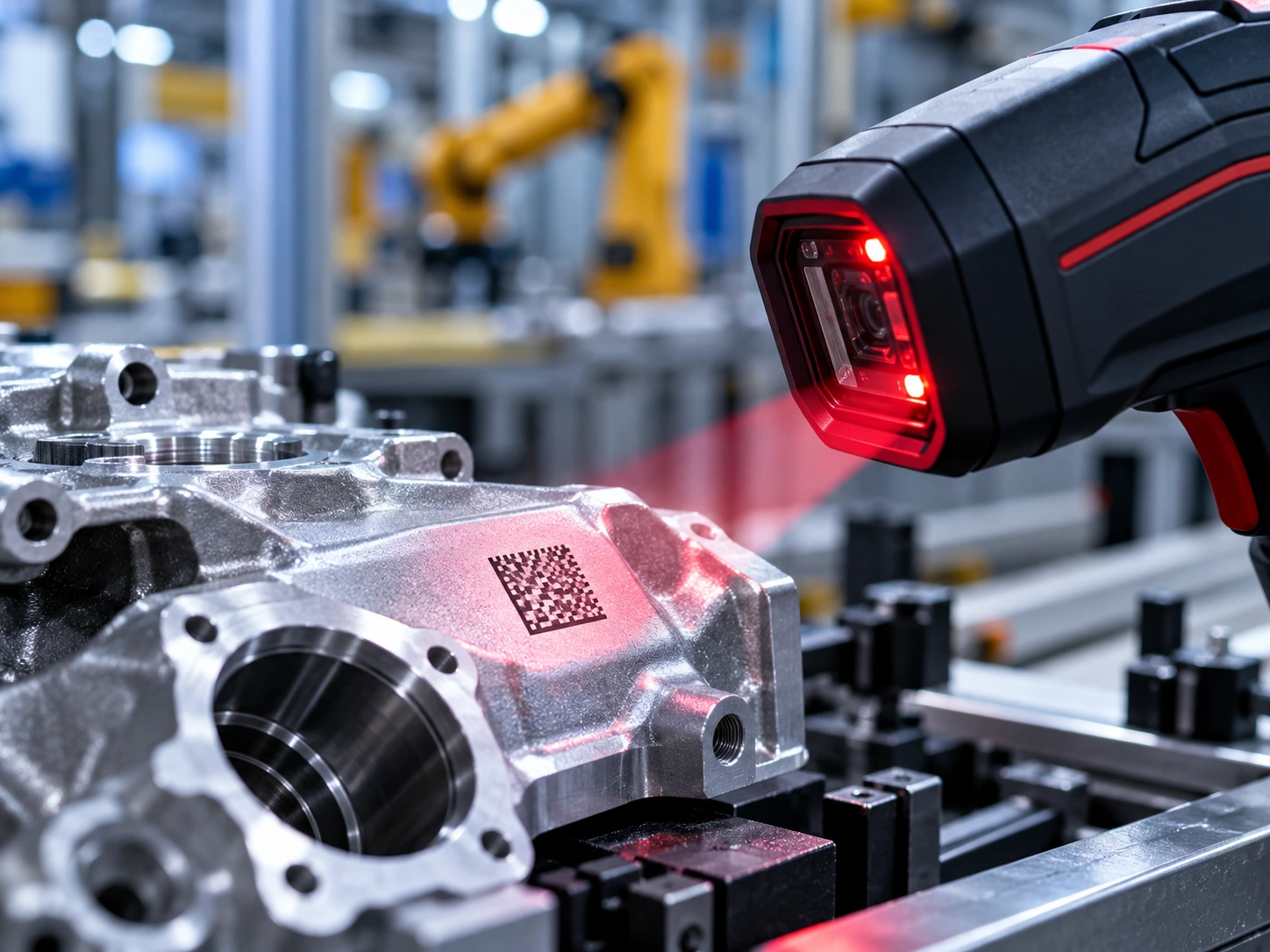
Manufacturers commonly use two-dimensional Data Matrix codes because they can encode identification information within a relatively small area. Depending on the application, a code may represent a serial number, part number, production batch, or another identifier linked to a database.
The code can then be read using a compatible industrial barcode reader or imaging scanner. When connected to manufacturing execution systems, inventory applications, or enterprise software, the captured information can help teams retrieve product records and track components across production stages.
How Does Direct Part Marking Work?
The process begins by selecting a suitable marking method based on the component material, surface condition, and identification requirements. Once the code has been applied, a compatible scanner reads it and software interprets the encoded information.
Common marking methods include:
- Laser marking: Uses a laser to create a mark on a suitable surface. The appearance and durability depend on the material and laser process.
- Dot peen marking: Creates characters or machine-readable codes through a controlled series of small indentations.
- Electrochemical etching: Uses an electrical and chemical process to create marks on suitable conductive materials.
Each method has different equipment requirements and material compatibility considerations. Manufacturers should evaluate mark readability, production speed, component geometry, and environmental exposure before selecting a process.
Find the Right DPM Scanning Solution for Your Business
Key Benefits of Direct Part Marking
1. Long-Lasting Component Identification
Because the identifier is applied directly to the part, it does not rely on an adhesive label remaining attached. This can be useful for metal components, tools, machinery, and products that experience frequent handling or demanding operating conditions.
However, mark durability depends on the marking method, substrate, and subsequent manufacturing processes.
2. Improved Product Traceability
A unique identifier can connect an individual component to relevant production records, inspection results, batch information, or service history. This helps manufacturers retrieve information when investigating quality issues or tracing components through distribution and maintenance.
The level of traceability depends on the information captured and how effectively scanning devices are integrated with business systems.
3. Space-Efficient Identification
Compact Data Matrix codes can carry useful identification data in a relatively small area. This makes them valuable for components where conventional labels may be impractical because of limited surface space.
The final code size must still account for marking quality, scanner capability, viewing distance, and the available marking area.
4. Better Support for Quality Control
Scanning identifiers at selected production checkpoints can help teams associate inspection results with the correct component. When supported by suitable software, this can improve record accuracy and make it easier to investigate production discrepancies.
5. Reduced Dependence on Separate Labels
For applications requiring permanent identification, marking the component directly can reduce reliance on printed labels and their associated consumables. Whether this reduces overall operating costs depends on marking equipment, production volume, maintenance, and implementation requirements.
Applications of Direct Part Marking Across Industries
Permanent component identification is valuable wherever products need to be distinguished and tracked throughout their lifecycle.
Automotive manufacturing: Engine components, transmission parts, and other automotive components may require identifiers that support production records, quality investigations, and service traceability.
Electronics manufacturing: Small components and printed circuit boards can use compact machine-readable codes to support identification, assembly tracking, and manufacturing records. Marking methods must be appropriate for the component and its surface.
Aerospace and industrial engineering: Components may require long-term identification for maintenance records, quality documentation, and lifecycle tracking. Applicable industry standards and customer requirements should guide implementation.
Medical device manufacturing: Permanent identification can support device traceability and applicable Unique Device Identification (UDI) requirements. Manufacturers must verify the relevant regulatory requirements for their markets and products.
Machinery and equipment manufacturing: Tools, industrial parts, and equipment components can be marked to connect physical items with asset records, maintenance histories, and manufacturing information.
Common Challenges in Reading Directly Marked Codes
Applying a mark is only one part of the process. Manufacturers also need to ensure that the code can be read reliably under actual operating conditions.
Reflective metal surfaces, curved components, low-contrast marks, surface texture, small code dimensions, and contamination can make scanning more difficult. A code that is readable under ideal lighting may perform differently on a production line.
Choosing the right scanner requires considering the marking method, code size, material, scanning distance, movement, lighting, and required read rate. Some applications benefit from industrial imaging scanners with suitable optics and lighting configurations.
Where code quality is critical, manufacturers may also need code verification equipment to assess marking quality against applicable requirements. Reading a code successfully and verifying its quality are different functions.
Explore Reliable DPM Barcode Scanners for Industrial Use
How to Choose the Right DPM Scanning Solution
Before investing in scanning equipment, manufacturers should assess the following factors:
- Marking format: Confirm whether the application uses Data Matrix, QR Code, or another supported symbology.
- Material and surface: Evaluate reflective, textured, curved, or coated components.
- Scanning environment: Consider lighting, movement, mounting space, and the distance between the scanner and part.
- System integration: Check compatibility with manufacturing execution systems, ERP platforms, and traceability software.
- Operational requirements: Define scanning frequency, code readability expectations, and whether quality verification is necessary.
Testing candidate equipment on representative production parts is an important step before full deployment. It helps confirm whether the scanner can read the actual marks under expected working conditions.
Finding the Right DPM Scanning Technology
Implementing Direct Part Marking requires more than selecting a barcode scanner. Manufacturers need to ensure that marked codes remain readable across different materials, component shapes, and production conditions.
Stallion Global helps businesses explore barcode scanning and data capture technologies for industrial identification applications. Its technology portfolio includes solutions from partners such as Honeywell and Datalogic, alongside mobile computing technologies from brands including Seuic and Sunmi. The most suitable option depends on the application and the manufacturer’s technical requirements.
Before selecting equipment, manufacturers should evaluate their actual marked components and test scanning performance under real operating conditions. Not every scanner supports every type of directly marked code, so compatibility should be confirmed against manufacturer specifications and application testing.
Conclusion
Direct Part Marking offers manufacturers a practical approach to permanent component identification, particularly when conventional labels are unsuitable. Combined with compatible scanning technology and properly integrated traceability software, it can support production visibility, quality processes, and reliable access to component information.
The right solution depends on the materials being marked, the code format, operating conditions, and the manufacturer’s traceability objectives. Evaluating these factors before implementation helps businesses choose technology that fits their production requirements.
Contact Stallion Global for Expert DPM Scanning Solutions
Frequently Asked Questions
Which barcode is commonly used for DPM?
Data Matrix is widely used because it can encode information in a compact two-dimensional symbol. The appropriate code format depends on the application and its identification requirements.
Can ordinary barcode scanners read DPM codes?
Some can, but not all. Readability depends on the scanner’s imaging technology, optics, lighting, code quality, and surface characteristics. Manufacturers should verify DPM compatibility before purchasing equipment.
What is the difference between DPM and barcode labels?
A conventional barcode label is attached to a product, whereas a directly marked code is applied to the component’s surface. Each method has advantages depending on cost, material, environmental exposure, and traceability requirements.
Does every industrial barcode scanner support DPM?
No. DPM reading depends on the scanner’s capabilities, optics, lighting, and the characteristics of the marked code. Manufacturers should test the intended code on representative components before finalising their equipment selection.