Barcode scanning has become an essential part of modern retail, warehousing, logistics, manufacturing, healthcare, and supply chain operations. From checkout counters to warehouse picking stations, businesses use barcode technology to capture product and asset information quickly and accurately.
However, choosing the right scanner requires an understanding of the different barcode types and scanning technologies available. The most common comparison businesses make is 1D vs 2D barcode scanners.
While both technologies automate data capture, they differ in the type of barcode they read, the amount of information they can process, scanning capabilities, and suitable applications. Understanding these differences can help businesses select the right barcode scanning solution for their operational requirements.
What Is a 1D Barcode Scanner?
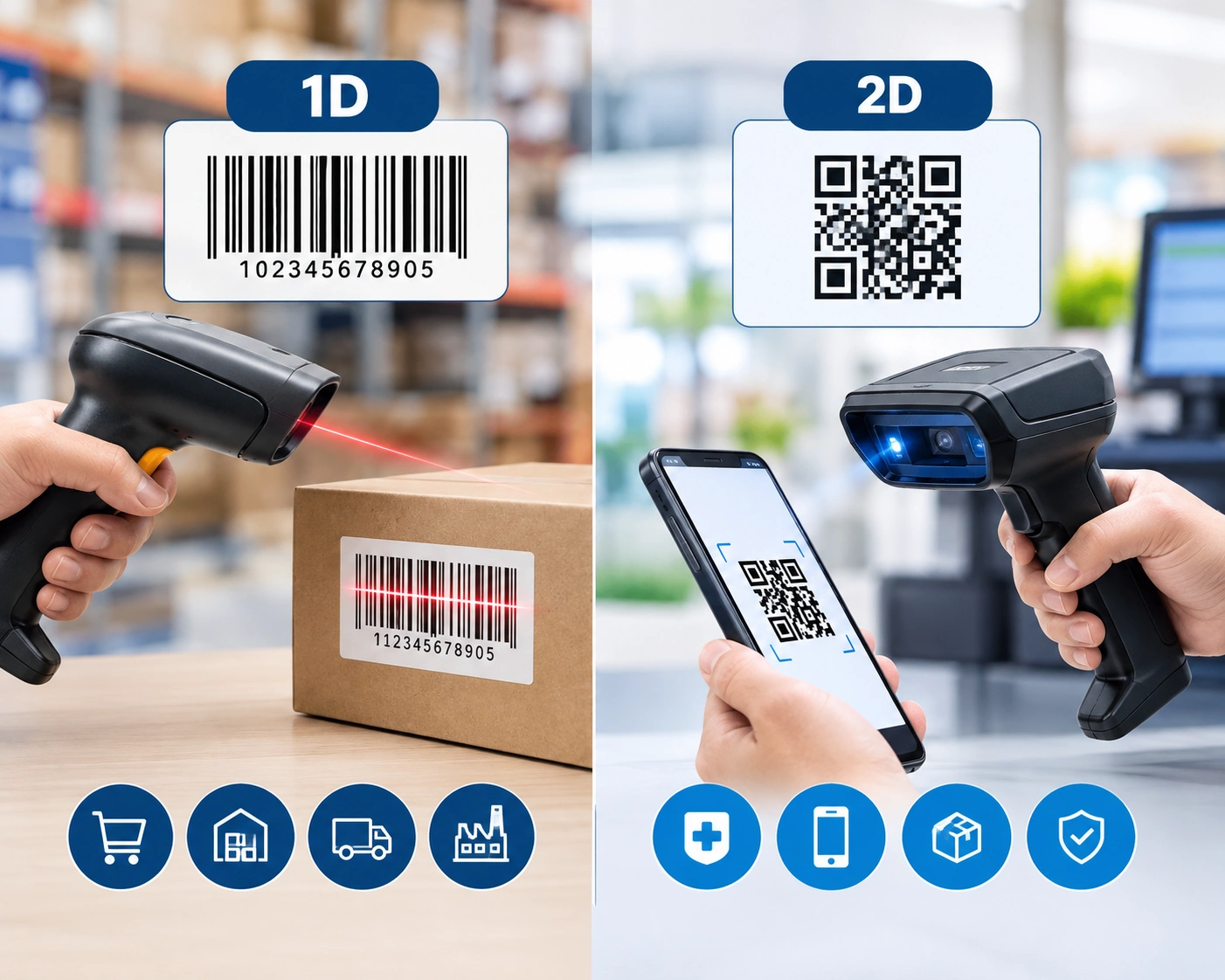
A 1D barcode scanner is designed to read one-dimensional or linear barcodes. These barcodes use parallel lines and spaces of different widths to represent information.
Common examples include UPC, EAN, Code 39, Code 128, ITF-14, and GS1-128. GS1 identifies UPC/EAN as widely used retail 1D barcodes, while GS1-128 and ITF-14 are also used in distribution and supply chain environments.
1D barcode scanners can use laser or imaging technology depending on the scanner model. They are commonly used for:
- Retail point-of-sale systems
- Supermarkets and grocery stores
- Inventory management
- Warehouse operations
- Product identification
- Shipping and receiving
- Distribution centres
- Document and asset tracking
For businesses whose workflows primarily depend on traditional linear barcodes, a 1D scanner can provide a practical and efficient data capture solution.
Get the Right Barcode Scanner for Your Workflow
What Is a 2D Barcode Scanner?
A 2D barcode scanner uses imaging technology to read two-dimensional barcodes, which store information through patterns of squares, dots, or other geometric elements.
Examples include QR Code, Data Matrix, and GS1 DataMatrix. Unlike traditional linear barcodes, 2D symbols can encode significantly more information within a relatively compact space.
2D imaging scanners are commonly used for:
- Retail and POS
- Healthcare and pharmaceuticals
- Manufacturing
- Warehousing and logistics
- Product traceability
- Mobile ticketing
- Asset tracking
- Inventory management
GS1 notes that 2D barcodes can encode information such as product identifiers, batch or lot numbers, serial numbers, and dates, depending on the applicable standard and data structure.
1D vs 2D Barcode Scanners: Key Differences
When comparing 1D vs 2D barcode scanners, businesses should look beyond the barcode’s visual appearance and consider the operational requirements.
Feature | 1D Barcode Scanner | 2D Barcode Scanner |
Barcode type | Linear/1D | Matrix/2D |
Common examples | UPC, EAN, Code 39, Code 128 | QR Code, Data Matrix, GS1 DataMatrix |
Data capacity | Generally lower | Generally higher |
Scanning technology | Laser or imaging | Imaging/camera-based |
Typical use | Product identification and POS | Traceability, inventory and data-rich applications |
Orientation | Often requires alignment | Generally more flexible |
Mobile/QR codes | Limited depending on model | Designed to support 2D codes |
Future 2D workflows | Limited | Better suited to 2D adoption |
The exact capabilities depend on the scanner model, barcode quality, software, and business environment.
For example, GS1 states that GS1 DataMatrix and GS1 QR Code require 2D imaging scanners for appropriate scanning applications.
Benefits of 1D Barcode Scanners
1D scanners remain useful where businesses primarily use traditional linear barcodes.
Fast product identification
Retail and distribution operations can quickly capture product identification information at checkout, receiving, or dispatch.
Simple barcode workflows
Businesses with established 1D barcode systems may not need the additional functionality of a 2D imager for every application.
Wide use across retail and distribution
UPC, EAN, GS1-128, and other linear barcode formats remain important across retail and supply chain operations.
Benefits of 2D Barcode Scanners
2D imaging technology provides additional capabilities for businesses handling more data-rich barcode applications.
Higher data capacity
2D barcodes can hold more information within a smaller physical symbol than conventional linear barcodes.
Supports QR codes and Data Matrix
A 2D barcode reader can support popular formats such as QR Code and Data Matrix, depending on the device’s specifications.
Supports traceability
Businesses can use data-rich barcode formats for applications involving serial numbers, batch information, expiry dates, and other attributes where supported by the relevant barcode standard.
Greater flexibility for modern workflows
2D scanners can support applications involving printed labels, mobile screens, compact codes, and more complex identification workflows.
Upgrade Your Business with Smart Barcode Scanning
Where Are Barcode Scanners Used?
The applications of barcode scanners extend across numerous industries.
Retail
Barcode scanners are fundamental to POS systems, product identification, billing, stock verification, and inventory management. Stallion Global provides barcode-enabled retail solutions that integrate scanners with POS, RFID, inventory, and warehouse technologies.
Warehousing and Logistics
In warehouses, barcode scanning can support receiving, put-away, picking, packing, shipping, and inventory audits. Integrated barcode solutions can improve visibility across warehouse and supply chain processes.
Manufacturing
Manufacturers can use barcode scanners for product tracking, work-in-progress identification, component tracking, quality processes, and production-line automation.
Healthcare
2D barcode technologies such as GS1 DataMatrix have applications in healthcare and can support the encoding of product and traceability information. GS1 specifically identifies healthcare among the areas where GS1 DataMatrix is used.
Asset and Inventory Management
Barcode readers can help organizations identify equipment, products, documents, and other assets while connecting captured information with inventory or asset management systems.
How to Choose Between 1D and 2D Barcode Scanners
The choice should be based on your barcode types, workflow, operating environment, scanning distance, connectivity, integration requirements, and future needs.
Consider these questions before purchasing:
- Do you only scan 1D barcodes?
- Do you need QR Code or Data Matrix support?
- Are employees scanning printed labels or mobile screens?
- Do you need handheld, wireless, fixed-mount, or rugged scanners?
- Will scanners connect to a POS, ERP, or WMS?
- Are scanners being used in retail or demanding industrial environments?
- Do you need a solution that supports future 2D barcode workflows?
Businesses should also consider scan speed, durability, connectivity, battery life, ergonomics, reading range, and compatibility with existing software.
Stallion Global: Barcode Scanning Solutions for Modern Businesses
Stallion Global has been working in the Automatic Identification and Data Capture (AIDC) sector since 1996 and provides barcode, RFID, POS, mobility, warehouse, retail, and automation solutions. Its published barcode portfolio includes handheld barcode scanners and mobile computing devices.
For businesses in Kerala, India, and across other markets served by Stallion Global, selecting barcode hardware is only one part of building an effective scanning environment. The scanner should work as part of the wider technology ecosystem, including barcode printers, labels, inventory management software, POS platforms, Warehouse Management Systems (WMS), RFID, and enterprise applications.
Stallion Global also provides automation scanning solutions for conveyor-based environments, including laser and image-based scanning systems, along with integration services for industrial applications.
Its experience across retail, logistics, manufacturing, healthcare, and other sectors enables businesses to evaluate barcode technology based on their actual workflows rather than simply choosing hardware based on specifications.
Make the Right Barcode Scanning Choice
Understanding 1D vs 2D barcode scanners helps businesses choose technology that aligns with their current operations while preparing for changing data-capture requirements. Whether your organization needs retail POS scanning, warehouse inventory tracking, manufacturing automation, healthcare identification, or supply chain visibility, the right scanner should integrate seamlessly with your broader technology environment.
With experience in AIDC, barcode, RFID, POS, mobility, warehouse management, and automation solutions, Stallion Global can help businesses evaluate scanning requirements and develop a solution around their operational needs.
Find the Right Barcode Scanner for Your Business
Frequently Asked Questions
Is a 2D barcode scanner better than a 1D scanner?
They serve different requirements. A 2D imager can read 2D symbols such as QR Code and Data Matrix and can also support many 1D barcodes, depending on the model. A 1D scanner may be sufficient when a business only needs to read traditional linear barcodes.
Can a 2D scanner read 1D barcodes?
Many 2D imaging scanners are designed to read both 1D and 2D barcodes. However, businesses should verify the supported symbologies before purchasing a specific model.
Which barcode scanner is suitable for retail?
The right choice depends on the retailer’s barcode types, POS system, scanning volume, and workflow. Retailers using QR codes or planning for 2D barcode adoption should evaluate 2D imaging scanners and POS compatibility. GS1’s current guidance also highlights the ongoing transition toward 2D barcode capabilities in retail.
What should businesses consider before buying a barcode scanner?
Consider barcode compatibility, scanning distance, scan volume, operating environment, connectivity, ergonomics, durability, software integration, and after-sales support. The scanner should match the business process rather than being selected solely on price or scan speed.