Businesses today manage large volumes of products, inventory records, assets, and operational data. Whether tracking materials in a manufacturing facility or processing orders in a warehouse, accurate information is essential for efficient operations. Manual data entry can create delays, increase errors, and make it difficult to maintain reliable records.
AIDC Technology helps businesses overcome these challenges by automatically identifying objects and capturing information through technologies such as barcode scanning, Radio Frequency Identification (RFID), and Optical Character Recognition (OCR).
Automatic Identification and Data Capture (AIDC) connects physical operations with digital business systems, allowing organizations to improve inventory accuracy, streamline workflows, and strengthen operational visibility.
For industries including retail, manufacturing, logistics, and healthcare, AIDC provides a practical foundation for digital transformation and business process automation.
What Is AIDC Technology?
AIDC stands for Automatic Identification and Data Capture. It refers to technologies that automatically identify objects, products, assets, or individuals and collect relevant information with minimal manual data entry.
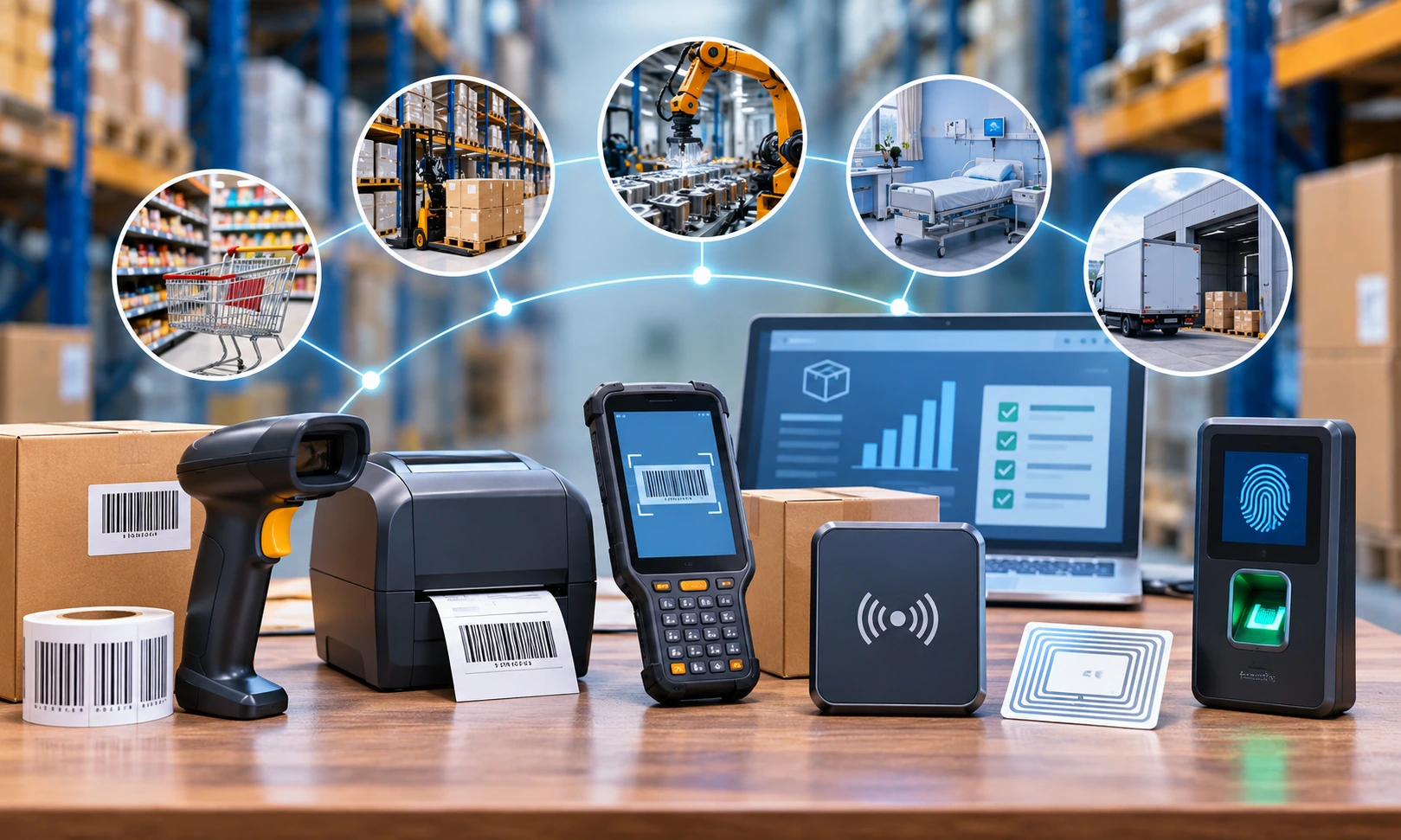
AIDC systems use identification methods such as barcodes, RFID tags, QR codes, and biometric recognition to capture information and transfer it into connected software applications.
For example, when a warehouse employee scans a product barcode, the scanner captures its identifier. The connected Warehouse Management System (WMS) can then retrieve product details, verify inventory records, or record stock movements.
By connecting physical identification with digital records, AIDC supports faster information processing and more consistent operational data.
How Does AIDC Technology Work?
Most automatic data capture systems follow a straightforward process:
- Identification: A product, asset, or package receives a unique identifier through a barcode, RFID tag, or another supported method.
- Data Capture: A barcode scanner, RFID reader, mobile computer, or other device captures the identifier.
- Data Transmission: The captured information is transferred to a connected application through a wired or wireless connection.
- Data Processing: Business software retrieves the corresponding records and processes the information.
- Record Updates: The system records relevant activities, such as inventory movements, product verification, or asset transactions.
For instance, during warehouse dispatch, scanning a package can help verify that the correct item is assigned to an order before shipment.
The actual workflow depends on the identification technology, software integration, and operational requirements.
Improve Inventory Accuracy with Advanced AIDC Solutions
What Are the Different Types of AIDC Technology?
Different identification technologies serve different business purposes. Selecting the right approach depends on factors such as scanning distance, environmental conditions, data requirements, and operational volume.
1. Barcode Technology
Barcode technology is among the most widely used automatic identification methods.
One-dimensional (1D) barcodes typically represent identifiers using parallel lines, while two-dimensional (2D) barcodes, including QR codes and Data Matrix symbols, can encode information in more compact formats.
Barcode scanners and industrial mobile computers capture these codes and transmit the information to connected applications.
Common applications: Retail billing, inventory management, product identification, warehouse picking, and shipment verification.
2. Radio Frequency Identification (RFID)
RFID technology uses radio waves to communicate between RFID tags and compatible readers.
Unlike conventional barcode scanning, many RFID systems can identify tagged items without requiring direct line of sight. Depending on the equipment, tags, and environment, multiple items may also be identified during a single reading operation.
Common applications: Asset tracking, warehouse inventory monitoring, manufacturing traceability, and supply chain visibility.
3. Optical Character Recognition (OCR)
OCR technology converts printed or handwritten text into machine-readable digital information.
It can help organizations capture information from documents, product markings, identification numbers, and other text-based records.
Common applications: Document processing, invoice data extraction, and industrial identification.
4. Biometric Identification
Biometric systems identify or verify individuals using characteristics such as fingerprints, facial features, or iris patterns.
These technologies are primarily used in applications requiring identity verification and controlled access.
Common applications: Employee authentication, access control, and identity management.
Key Benefits of AIDC Technology for Businesses
Implementing automatic identification and data capture can improve operational efficiency across multiple business functions.
Improved Data Accuracy
Automated data capture reduces dependence on manually typing product codes and identification numbers. This helps minimize transcription errors and supports more reliable records.
Faster Operational Workflows
Barcode scanners and mobile data collection devices enable employees to identify products and record transactions efficiently, reducing time spent on repetitive data entry.
Better Inventory Visibility
When integrated with inventory management software, AIDC systems can provide timely updates about stock receipts, transfers, picking, and dispatch activities.
Enhanced Product Traceability
Unique identifiers help businesses track products, materials, and assets across operational stages. This is particularly valuable for manufacturing quality control and logistics verification.
Reduced Operational Costs
More accurate data collection can help reduce avoidable rework, inventory discrepancies, and time spent correcting records.
Improved Business Decision-Making
Reliable operational information supports inventory planning, resource allocation, performance monitoring, and supply chain management.
These benefits depend on appropriate system configuration, employee training, and integration with existing business processes.
Applications of AIDC Across Industries
AIDC Technology supports various industries by connecting identification devices with operational software.
Warehouse and Logistics
Warehouses use barcode scanning technology, RFID readers, and mobile computers for receiving, put-away, picking, packing, and dispatch verification.
Integration with a Warehouse Management System helps maintain inventory records and improve order fulfilment accuracy.
Manufacturing
Manufacturers use barcode and RFID solutions to identify raw materials, monitor Work-in-Progress (WIP), track production batches, and maintain product traceability.
Scanning at production checkpoints helps record material movements and provides visibility into manufacturing workflows.
Retail
Retail businesses use barcode scanners, Point of Sale (POS) systems, and barcode label printers to simplify billing, identify products, and manage inventory transactions.
Healthcare
Healthcare organizations use barcode identification and RFID-based systems for equipment tracking, inventory management, and selected patient safety workflows.
Asset and Document Management
Reliable operational information supports inventory planning, resource allocation, performance monitoring, and supply chain management.
These benefits depend on appropriate system configuration, employee training, and integration with existing business processes.
Find the Right AIDC Solution for Your Business Needs
AIDC vs Manual Data Entry: What's the Difference?
Factor | Manual Data Entry | AIDC Systems |
Data collection | Information entered manually | Information captured through devices |
Accuracy | More exposed to typing errors | Reduces manual transcription |
Processing | Depends on manual entry speed | Supports faster identification |
Traceability | Requires consistent manual records | Can automatically record transactions |
System integration | Often requires additional entry | Can connect directly with business software |
Scalability | Increasing workload requires more manual effort | Supports higher transaction volumes |
While manual entry may remain suitable for occasional transactions, automated data collection becomes increasingly valuable as operational complexity grows.
How to Choose the Right AIDC Solution
Choosing an identification system requires understanding how information moves through business operations.
Organizations should evaluate:
- Operational requirements: Identify whether the priority is inventory tracking, asset management, production monitoring, or retail billing.
- Technology suitability: Consider barcode scanning for cost-effective item identification and RFID where non-line-of-sight or bulk identification offers practical advantages.
- Working environment: Assess scanning distance, lighting, dust, moisture, and equipment durability.
- Software compatibility: Confirm integration requirements with ERP, WMS, POS, or asset management systems.
- Future scalability: Select hardware and software that can support changing operational needs.
GS1 identification standards can also help organizations maintain consistent product identification and improve information exchange across supply chains.
A successful implementation should consider the complete workflow rather than selecting identification hardware independently.
AIDC Solutions from Stallion Global
With a business history dating back to 1996, Stallion Global works in automatic identification, data capture, and business automation solutions.
Its solution portfolio includes barcode scanners, barcode printers, RFID technology, mobile computing devices, and integrated identification solutions for industries such as retail, manufacturing, warehousing, and logistics.
By combining suitable identification hardware with business software, organizations can develop connected workflows that support inventory management, asset tracking, and operational traceability.
The right implementation depends on identifying existing process challenges, selecting compatible technologies, and ensuring that captured information reaches the systems where it is needed.
Streamline Your Operations with Barcode and RFID Solutions
Frequently Asked Questions
1. What is AIDC in simple terms?
AIDC is a method of automatically identifying products, assets, or people and collecting information using technologies such as barcodes, RFID, and biometrics.
2. What is the difference between AIDC and RFID?
AIDC is the broader category of automatic identification and data capture technologies. RFID is one technology within that category that uses radio waves to identify tagged objects.
3. Which industries benefit from AIDC solutions?
Retail, manufacturing, warehousing, logistics, healthcare, and asset-intensive businesses commonly use automatic identification systems.
4. Can AIDC integrate with ERP and warehouse management software?
Yes. Compatible AIDC devices can integrate with ERP, WMS, POS, and asset management applications through supported interfaces, middleware, or software integrations.