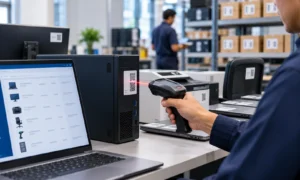
Every online order creates a chain of activities, from confirming product availability to preparing shipments and coordinating delivery. As order volumes increase, even small identification errors can result in incorrect deliveries, delayed dispatches, and costly returns.
Barcode Technology in E-commerce Logistics helps businesses manage these challenges by connecting product identification, order processing, parcel tracking, and shipping verification through automated data capture.
For growing online retailers and logistics providers, barcode-enabled workflows offer a practical way to maintain fulfilment accuracy, improve shipment visibility, and support business expansion without unnecessarily complicating operations.
What Is Barcode Technology in E-commerce Logistics?
Barcode technology uses machine-readable symbols to identify products, packages, and shipments throughout the e-commerce fulfilment process.
A typical solution combines barcode scanners, thermal label printers, mobile computers, and software platforms such as an Order Management System (OMS) or Warehouse Management System (WMS).
Each scan captures an identifier that the connected application uses to retrieve information or record an activity.
For example, a product barcode identifies an item during order picking, while a shipping label barcode identifies the parcel during sorting and courier handling.
These identifiers serve different purposes but work together to create a more organised order-to-delivery process.

Reduce Order Errors with Smart Barcode Solutions!
How Barcode Technology Supports the E-commerce Order Lifecycle
1. Accurate Order Picking and Verification
E-commerce businesses frequently manage multiple product variants, including different sizes, colours, and packaging options.
Selecting the wrong variant can lead to customer complaints and additional return costs.
Barcode-based order verification allows fulfilment employees to scan selected products against order details.
If an incorrect Stock Keeping Unit (SKU) is scanned, a properly configured system can alert the employee before packing.
This additional verification step helps reduce picking errors and supports more dependable order fulfilment.
2. Shipping Label Printing and Parcel Identification
Shipping labels connect physical parcels with delivery information.
Barcode label printers generate machine-readable identifiers that courier and logistics systems use during shipment processing.
Depending on the carrier’s requirements, labels may contain Code 128, GS1-128, or other supported barcode formats.
Each parcel identifier is associated with shipment information in the relevant system.
Clear printing, suitable label materials, and correct barcode placement help improve scanning reliability during sorting and transportation.
For high-volume e-commerce operations, dependable barcode label printing is essential for maintaining consistent dispatch workflows.
3. Courier Handover and Shipment Tracking
Once an order is packed, the next challenge is transferring it accurately to the logistics provider.
Barcode scanning can record parcel movement during dispatch, courier collection, sorting, and delivery processing.
These scanning events create shipment status updates when connected to the appropriate logistics platform.
This supports order tracking and traceability while helping businesses investigate delayed or misplaced shipments.
However, end-to-end tracking depends on data sharing between the retailer, fulfilment provider, and courier network.
4. Faster Returns and Reverse Logistics
Returns are an unavoidable part of online retail, particularly for businesses handling fashion, electronics, and consumer products.
A barcode-based returns process helps employees identify returned parcels and match them with the original order.
After scanning, the system can guide inspection, product classification, restocking, or replacement workflows.
For example, a returned item in saleable condition may be scanned back into available inventory after inspection.
This reduces manual identification work and supports more organised reverse logistics operations.
5. Multi-Channel Inventory Synchronization
Online retailers often sell through websites, marketplaces, and physical stores simultaneously.
Managing inventory across these channels becomes difficult when stock records are maintained separately.
Barcode scanning for e-commerce helps capture stock movements at fulfilment locations.
When integrated with an OMS, WMS, or Enterprise Resource Planning (ERP) platform, these transactions can support inventory synchronization across sales channels.
This helps businesses make more reliable decisions about product availability and order allocation.
How Barcode Tracking Works in an E-commerce Fulfilment Centre
Barcode Technology in E-commerce Logistics connects several operational checkpoints into a coordinated process.
Consider an online retailer processing orders from multiple sales channels.
- Order received: The OMS records the customer order and communicates fulfilment requirements.
- Product picking: Employees scan product barcodes to verify the correct SKUs.
- Packing: Items are checked against order details before the parcel is sealed.
- Shipping label generation: A thermal printer produces the carrier-compatible shipping label.
- Dispatch verification: The parcel barcode is scanned before courier handover.
- Delivery updates: Subsequent carrier scans update shipment tracking information.
- Returns processing: Returned products are identified and processed against the original transaction.
This workflow reduces disconnected manual activities and creates a clearer record of each shipment’s progress.
Make Every Order Count with Smarter Barcode Technology!
Choosing the Right Barcode Solutions for E-commerce Logistics
Selecting suitable equipment depends on transaction volumes, operating conditions, and software compatibility.
Handheld barcode scanners are useful for product verification, while presentation or fixed scanners may support repetitive scanning tasks.
Thermal barcode printers are commonly used for shipping labels, and rugged mobile computers enable employees to access order information while moving through fulfilment areas.
Businesses should also evaluate wireless connectivity, label durability, barcode readability, and integration requirements.
For specialised applications, Radio Frequency Identification (RFID) may complement conventional barcode identification.
The objective is to build a practical system that supports existing workflows and can accommodate future operational growth.
Best Practices for Reliable E-commerce Barcode Operations
Effective implementation requires consistent identification and scanning procedures.
Businesses should use appropriate barcode formats, assign unique identifiers where required, and maintain readable labels.
Product identifiers such as Global Trade Item Numbers (GTINs) can support standardised product identification within relevant GS1 systems.
Regular printer maintenance, barcode quality checks, employee training, and software testing help prevent avoidable scanning failures.
Monitoring failed scans, order discrepancies, and return reasons can also reveal opportunities for process improvement.
Why Choose Stallion Global for E-commerce Logistics Solutions?
Established in 1996, Stallion Global brings decades of experience in Automatic Identification and Data Capture (AIDC) technologies and business automation.
Its technology partnerships include Honeywell Partner, Datalogic Partner, and Avery Dennison Partner, demonstrating established relationships with recognised technology providers.
Stallion Global offers barcode scanners, barcode printers, mobile computing devices, RFID technologies, and related automation solutions.
With a presence across India, the UAE, Qatar, and Oman, the company supports businesses operating in different retail and logistics environments.
Its understanding of identification hardware, labelling technologies, and software requirements helps organisations evaluate suitable solutions for order fulfilment, parcel identification, and logistics workflows.
Conclusion
Barcode Technology in E-commerce Logistics provides an effective foundation for accurate order processing, reliable parcel identification, and better shipment visibility.
By connecting barcode scanning, shipping label printing, mobile computing, and logistics software, businesses can improve fulfilment workflows and prepare for growing order volumes.
Optimize Your E-commerce Logistics with Stallion Global!
Frequently Asked Questions
Which barcode types are used in e-commerce shipping?
Code 128 and other carrier-specified barcode formats are commonly used for shipping labels. The correct format depends on the courier, application, and identification requirements.
Can barcode systems integrate with e-commerce platforms?
Yes. Compatible barcode systems can work with OMS, WMS, and ERP software through supported applications and integrations.
How do barcodes help reduce incorrect deliveries?
Scanning products during picking and verifying parcels before dispatch helps identify mismatches before orders enter the delivery network.