Managing inventory efficiently is essential for businesses looking to improve productivity, reduce operational costs, and deliver better customer experiences. Whether you run a retail store, warehouse, manufacturing plant, logistics company, healthcare facility, or distribution center, inaccurate inventory records can lead to stock shortages, excess inventory, delayed deliveries, and lost revenue.
A Barcode Inventory Management System helps businesses overcome these challenges by automating inventory tracking and providing real-time visibility into stock movements. Instead of relying on manual data entry, barcode technology enables employees to capture accurate information instantly, reducing errors and improving operational efficiency.
With over 30 years of experience, Stallion Global has been delivering enterprise barcode solutions across India, UAE, Qatar, and Oman. We help organizations implement complete automation solutions, including barcode scanners, barcode printers, RFID systems, mobile computers, Warehouse Management Systems (WMS), and ERP integrations. Backed by trusted technology partners such as Honeywell, Datalogic, Avery Dennison, Alien Technology, Sunmi, Seuic, BoxPOS, and BoxRF, we provide end-to-end solutions tailored to every industry.
In this guide, you’ll learn what a barcode inventory management system is, how it works, its key benefits, and how to choose the right solution for your business.
Why Businesses Need a Barcode Inventory Management System
Manual inventory tracking often results in errors, duplicate entries, misplaced stock, and inaccurate reporting. As businesses grow, these issues become more costly and difficult to manage.
A Barcode Inventory Management System simplifies inventory management while improving visibility across the entire supply chain.
Key Benefits
- Improve inventory accuracy
- Reduce manual data entry
- Speed up receiving and dispatch
- Minimize stock discrepancies
- Increase warehouse productivity
- Improve order fulfillment accuracy
- Enable real-time inventory visibility
- Reduce operational costs
- Enhance customer satisfaction
Studies show that barcode-based inventory systems can significantly improve inventory accuracy while reducing the time required for inventory counting compared to manual methods.
How Does a Barcode Inventory Management System Work?
A barcode inventory system follows a simple workflow that captures accurate inventory data at every stage.
Step 1: Barcode Creation
Each product is assigned a unique barcode label printed using industrial barcode printers.
Step 2: Barcode Scanning
Employees scan products using handheld scanners, wireless scanners, industrial scanners, or mobile computers during receiving, storage, picking, packing, and shipping.
Step 3: Real-Time Data Updates
Every scan automatically updates the inventory management software, eliminating manual entry and reducing errors.
Step 4: Inventory Monitoring
Managers gain instant visibility into stock availability, inventory movement, and warehouse operations through centralized dashboards.
Step 5: Reporting & Analytics
The system generates reports on inventory trends, stock movement, purchasing, and operational performance, helping businesses make better decisions.
Looking for the Right Barcode Inventory Management Solution?
From barcode scanners and printers to RFID, WMS, and ERP integration, our experts are here to help you choose the right solution for your business.
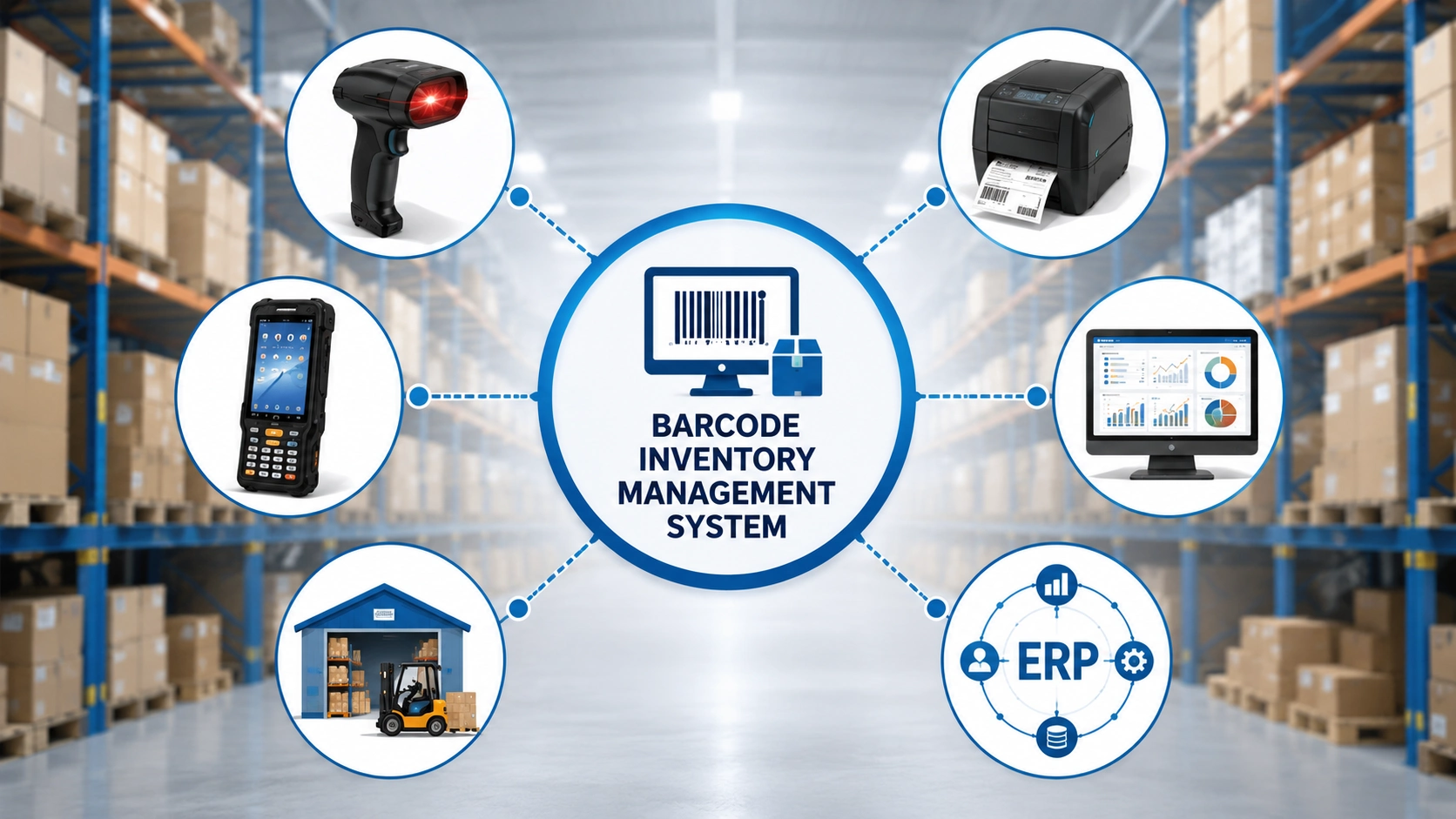
Key Components of an Effective Barcode Inventory Management System
Choosing the right solution involves selecting technologies that work seamlessly together.
Barcode Scanners
Barcode scanners capture inventory data quickly and accurately. Businesses can choose from handheld, wireless, presentation, industrial, or long-range scanners depending on operational requirements.
Barcode Printers
Barcode printers produce durable, high-quality labels that remain readable even in demanding warehouse and manufacturing environments.
Mobile Computers
Mobile computers combine barcode scanning with enterprise applications, enabling employees to update inventory and access real-time information from anywhere in the facility.
Inventory Management Software
The software records inventory transactions, monitors stock levels, generates reports, and provides complete inventory visibility.
Warehouse Management System (WMS)
Integrating barcode technology with a WMS streamlines receiving, put-away, picking, packing, shipping, and cycle counting processes.
ERP Integration
Connecting barcode systems with ERP software ensures inventory, purchasing, finance, and operations share accurate real-time data.
Manual Inventory vs Barcode Inventory Management
Manual Inventory | Barcode Inventory Management System |
Manual data entry | Automatic barcode scanning |
Higher risk of errors | High inventory accuracy |
Slow inventory counts | Faster stock audits |
Delayed inventory updates | Real-time inventory visibility |
Increased labor costs | Improved productivity |
Difficult to scale | Easily scalable for growing businesses |
Transform Your Inventory with the Right Technology
From barcode hardware to complete inventory automation solutions, Stallion Global delivers everything you need to streamline your operations.
How to Choose the Right Barcode Inventory Management System
Every business has different operational requirements. Before investing, evaluate these key factors:
- Business size and inventory volume
- Industry-specific requirements
- 1D or 2D barcode compatibility
- Warehouse or retail environment
- Scanner durability and scanning distance
- Integration with ERP, WMS, and POS software
- Future scalability
- Technical support and after-sales service
Expert Tip from Stallion Global: Choose a solution that can scale with your business. Investing in a barcode system that supports ERP integration, Warehouse Management Systems, and 2D barcode scanning helps reduce future upgrade costs while supporting long-term business growth.
Industry Applications of Barcode Inventory Management Systems
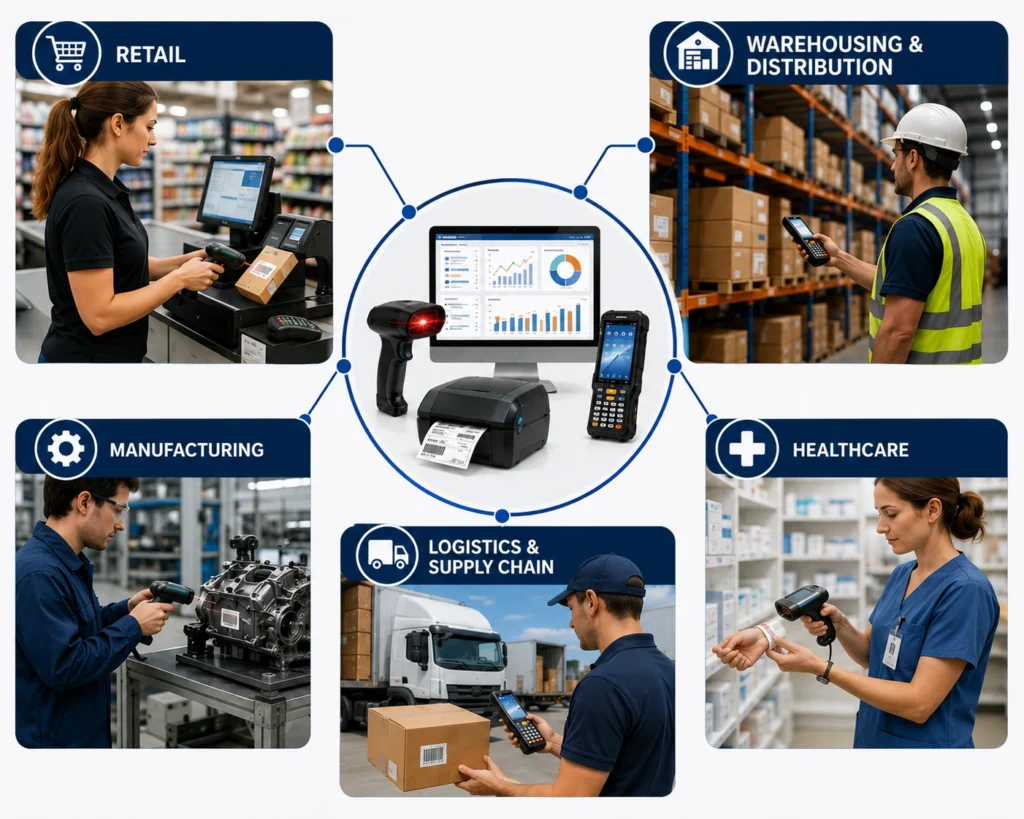
A Barcode Inventory Management System delivers measurable benefits across industries by improving inventory accuracy, increasing operational efficiency, and providing real-time visibility into stock movements. Whether you manage a single warehouse or multiple business locations, barcode technology helps streamline operations while reducing manual effort.
Retail
Retail businesses handle thousands of products daily, making inventory accuracy essential for smooth operations.
Benefits include:
- Faster checkout and billing
- Real-time stock visibility
- Accurate inventory tracking
- Reduced stockouts and overstocking
- Improved customer satisfaction
By integrating barcode scanners with Retail POS and inventory management software, retailers can synchronize sales and inventory data instantly.
Warehousing & Distribution
Warehouse operations require fast and accurate inventory movement. Barcode systems automate receiving, put-away, picking, packing, shipping, and cycle counting.
Key advantages:
- Real-time inventory visibility
- Faster order fulfillment
- Improved picking accuracy
- Reduced inventory discrepancies
- Higher warehouse productivity
When integrated with a Warehouse Management System (WMS), barcode technology helps optimize storage space and improve operational efficiency.
Logistics & Supply Chain
Logistics companies rely on barcode technology to monitor shipments from dispatch to delivery.
Benefits include:
- Shipment verification
- Proof of delivery
- Package tracking
- Fleet inventory management
- Better supply chain visibility
Wireless barcode scanners and rugged mobile computers allow employees to capture accurate information from virtually any location.
Manufacturing
Manufacturers use barcode systems to track raw materials, work-in-progress, and finished goods throughout production.
Barcode technology enables:
- Production tracking
- Product traceability
- Quality control
- Inventory accuracy
- Reduced production delays
Industrial barcode scanners and mobile computers provide reliable performance in demanding production environments.
Healthcare
Hospitals and healthcare organizations depend on barcode technology to improve patient safety and inventory control.
Common applications include:
- Patient identification
- Medication verification
- Laboratory sample tracking
- Pharmacy inventory management
- Medical equipment tracking
Barcode-based workflows reduce errors while improving operational efficiency.
Why should businesses choose Stallion Global?
Implementing barcode technology requires more than just selecting the right hardware. Success depends on choosing an experienced technology partner who understands your business processes and can deliver a complete, scalable solution.
For over 30 years, Stallion Global has been helping businesses automate operations through intelligent barcode and enterprise mobility solutions. We provide end-to-end services—from consultation and solution design to deployment, integration, training, and ongoing technical support.
Our Barcode & Automation Solutions
- Barcode Scanners
- Barcode Printers
- Barcode Labels & Consumables
- RFID Solutions
- Mobile Computers
- Warehouse Management Solutions (WMS)
- Inventory Management Solutions
- Asset Tracking Solutions
- Retail POS Solutions
- ERP & Business Software Integration
Trusted Global Technology Partners
Stallion Global works with globally recognized AIDC and automation brands, including:
- Honeywell
- Datalogic
- Avery Dennison
- Alien Technology
- Sunmi
- Seuic
- BoxPOS
- BoxRF
These partnerships enable us to deliver reliable, future-ready solutions tailored to retail, warehousing, manufacturing, healthcare, logistics, and distribution businesses.
Looking for a Complete Inventory Automation Solution?
Common Mistakes to Avoid
Many businesses invest in barcode technology without evaluating their long-term operational requirements.
Avoid these common mistakes:
- Choosing a scanner based only on price
- Using consumer-grade devices in industrial environments
- Ignoring ERP or WMS integration
- Selecting hardware that cannot scale with business growth
- Overlooking after-sales service and technical support
- Choosing incompatible barcode labels or printers
Working with an experienced solution provider helps ensure your investment delivers long-term value and maximum return.
Transform Your Inventory Management with Stallion Global
Choosing the right Barcode Inventory Management System is more than a technology investment—it’s a strategic step toward improving operational efficiency, inventory accuracy, and business growth. Whether you operate a retail store, warehouse, manufacturing facility, logistics company, or healthcare organization, the right barcode solution can help you reduce costs, increase productivity, and gain real-time visibility across your operations.
With more than 30 years of expertise in barcode and enterprise automation, Stallion Global has become a trusted partner for organizations across India and the Middle East. Our comprehensive portfolio of barcode scanners, barcode printers, RFID solutions, mobile computers, inventory management systems, and warehouse automation technologies is designed to meet the evolving needs of modern businesses.
From initial consultation and system design to deployment, integration, and long-term technical support, our team is committed to delivering solutions that drive measurable business results.
Frequently Asked Questions
1. What is a Barcode Inventory Management System?
A Barcode Inventory Management System combines barcode labels, scanners, printers, software, and business applications to automate inventory tracking, improve stock accuracy, and provide real-time visibility into inventory movement.
2. Can barcode inventory systems integrate with ERP and Warehouse Management Systems?
Yes. Modern barcode inventory systems integrate seamlessly with ERP software, Warehouse Management Systems (WMS), Retail POS platforms, and inventory management software, enabling businesses to automate workflows and maintain accurate inventory records across departments.
3. Which industries benefit most from barcode inventory management?
Barcode inventory systems are widely used in retail, warehousing, manufacturing, logistics, healthcare, pharmaceuticals, distribution, and e-commerce. Any organization managing inventory can benefit from improved accuracy, faster operations, and better inventory visibility.