
Healthcare Management Solutions
Healthcare organizations manage thousands of patient, inventory, equipment, and information-related activities every day. Accurate identification and timely data capture are essential for maintaining efficient workflows, reducing manual errors, and supporting patient safety.
Healthcare Management Solutions can combine barcode technology, RFID, mobile computing, printing, and data-capture technologies to improve operational processes across hospitals, clinics, laboratories, pharmacies, and other healthcare environments.
Stallion Global provides AIDC and enterprise technology solutions designed to support healthcare workflows such as patient identification, specimen tracking, medical inventory management, equipment tracking, and supply management. Our approach focuses on selecting technologies that fit the organization’s workflow, environment, and operational requirements.
What Are Healthcare Management Solutions?
Healthcare management technology encompasses systems and tools that help healthcare organizations manage operational information, resources, identification processes, and workflows more efficiently.
In an AIDC-enabled healthcare environment, barcodes, QR codes, RFID tags, mobile computers, and specialized printers can be used to identify patients, medicines, specimens, medical supplies, and equipment.
These technologies can support:
- Patient identification and tracking
- Patient wristband printing
- Medical inventory management
- Pharmaceutical and consumables tracking
- Medical equipment identification
- Asset location and lifecycle tracking
- Laboratory specimen identification
- Barcode-based data capture
- RFID-based identification
- Mobile healthcare workflows
- Label and document printing
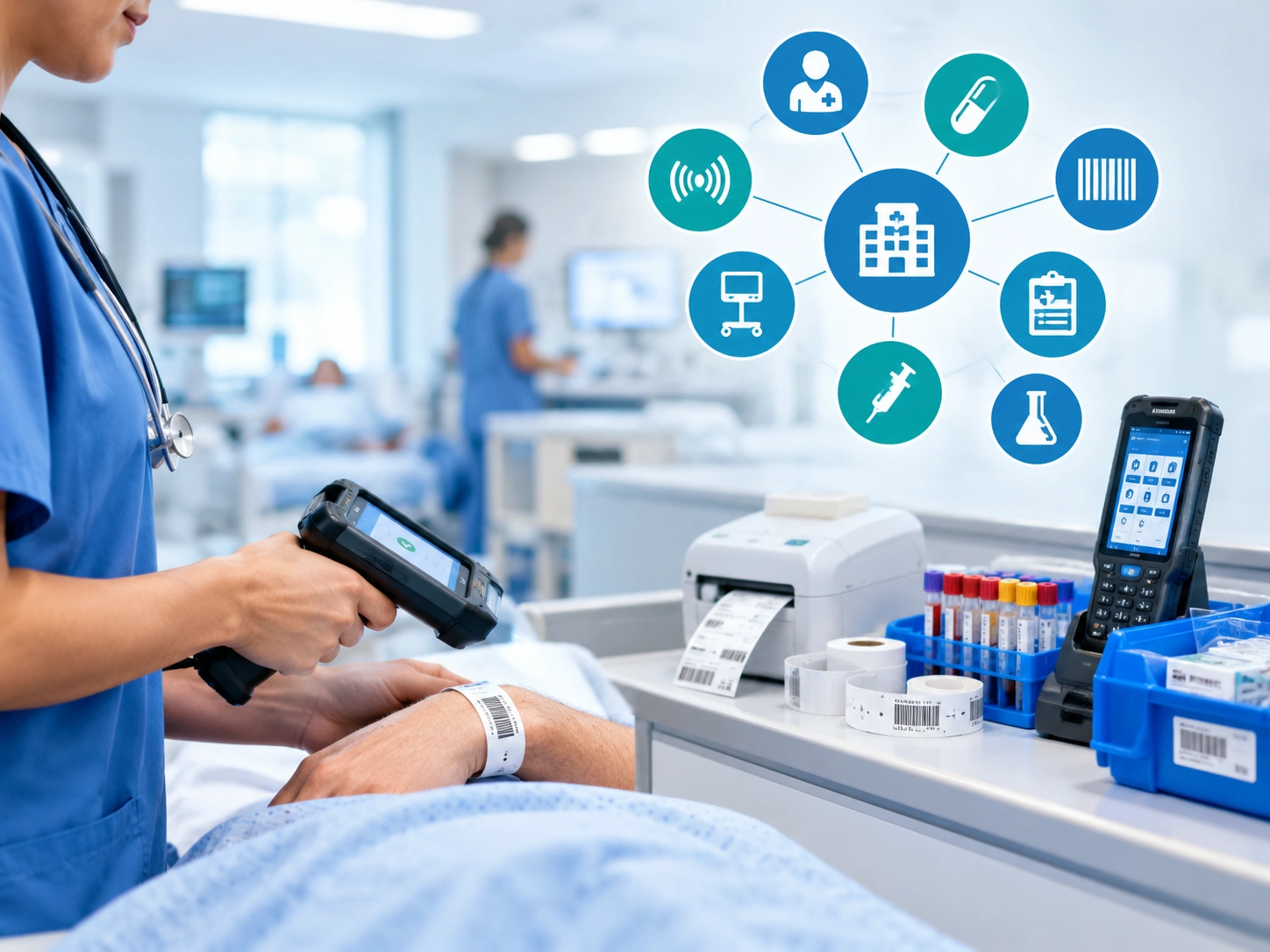
The appropriate technology depends on the healthcare facility, application, existing systems, regulatory requirements, and operating environment.
Get the Right Barcode & RFID Solution for Healthcare
Patient Identification and Tracking
Accurate patient identification is an important part of healthcare operations. Barcode-enabled identification can help healthcare personnel associate patients with relevant information throughout different stages of care.
Patient wristbands can include machine-readable identifiers that can be scanned using compatible barcode devices. This can support identification during registration, medication-related workflows, diagnostics, sample collection, and other activities.
Mobile barcode scanners and handheld computers can allow authorized personnel to capture information at the point of care instead of relying entirely on manual entry.
The exact workflow and system integration should be designed according to the healthcare organization’s clinical processes and information-management requirements.
Medical Inventory Management
Healthcare facilities depend on the availability of medicines, consumables, surgical supplies, laboratory materials, and other critical resources. Poor inventory visibility can contribute to stock shortages, excess inventory, expired products, or difficulties locating required supplies.
Barcode-based inventory management provides a structured method for identifying and tracking products as they are received, stored, issued, transferred, or replenished.
Healthcare teams can use barcode scanners and mobile computers to record:
- Product identification
- Batch or lot information
- Serial numbers
- Stock quantities
- Storage locations
- Expiry dates
- Inventory movements
This creates more consistent records and can help organizations improve inventory accuracy and supply visibility.
Medical Asset and Equipment Tracking
Hospitals and healthcare facilities use a wide range of equipment, including diagnostic devices, infusion equipment, patient-care equipment, mobile carts, and other valuable assets.
Tracking these resources manually can become difficult across large facilities. Barcode and RFID technologies can provide a digital identity for individual assets and help organizations maintain more structured records.
Depending on the implementation, asset tracking can support:
- Equipment identification
- Location tracking
- Asset allocation
- Maintenance records
- Equipment utilization
- Lifecycle management
- Audit and inventory activities
RFID can be particularly useful where organizations require automated identification or reduced dependence on line-of-sight scanning.
Laboratory and Specimen Identification
Laboratories handle a large number of samples that must remain correctly associated with patients and test requests.
Barcode labels can provide machine-readable identification for specimens such as blood samples, tissue samples, and other laboratory materials. Scanning at relevant checkpoints can help establish traceability as specimens move through collection, processing, testing, and storage.
Barcode printers and specialized labels can be selected according to specimen type, label size, environmental conditions, and durability requirements.
Healthcare Barcode and RFID Technologies
Barcode Scanners
Healthcare barcode scanners can capture patient, product, specimen, medication, and asset information. Depending on the application, organizations may require 1D or 2D scanning capabilities, hands-free scanning, disinfectant-ready housings, or specific connectivity options.
Mobile Computers
Rugged and handheld mobile computers can provide healthcare personnel with access to authorized applications while moving between departments, storage areas, laboratories, and other operational locations.
Barcode and Label Printers
Healthcare environments may require printers for patient wristbands, specimen labels, pharmacy labels, inventory labels, asset labels, and other identification materials. Direct thermal and thermal transfer printing can be selected based on the specific application and label requirements.
RFID Technology
RFID enables identification without requiring direct line-of-sight scanning. It can support applications such as equipment tracking, inventory visibility, and automated identification where the operating environment and workflow are suitable.
Build Smarter Healthcare Workflows with Stallion Global
Healthcare Workflow Applications
A technology-enabled healthcare environment can support a range of operational activities, including:
- Patient identification
- Patient wristband printing
- Medication identification
- Specimen tracking
- Laboratory sample identification
- Medical inventory management
- Pharmacy inventory
- Consumables tracking
- Medical equipment tracking
- Asset identification
- Equipment maintenance workflows
- Supply chain management
- Mobile data capture
- Healthcare label printing
These applications can be implemented individually or as part of a broader data-capture strategy depending on the organization’s priorities.
Connecting AIDC Technology with Healthcare Systems
Healthcare organizations may already use Hospital Information Systems (HIS), Electronic Health Records (EHR), Electronic Medical Records (EMR), Laboratory Information Systems (LIS), pharmacy systems, ERP platforms, or specialized applications.
Barcode scanners, mobile computers, printers, and RFID technologies can act as the data-capture layer within these environments.
For example, a barcode scan can provide an identifier that is then processed by the relevant application. The exact integration depends on software capabilities, APIs, databases, network connectivity, security requirements, and the organization’s workflow.
For this reason, successful implementation requires consideration of both the physical technology and the software environment in which it will operate.
How to Choose the Right Healthcare Technology
Healthcare organizations should evaluate several factors before selecting AIDC equipment.
Application requirements: Identify whether the technology will be used for patients, specimens, inventory, medication, or assets.
Scanning requirements: Consider barcode type, scanning distance, scan frequency, and whether hands-free operation is required.
Environmental conditions: Devices may need to withstand frequent cleaning, handling, moisture, dust, or other facility-specific conditions.
Printing requirements: Consider wristbands, specimen labels, pharmacy labels, inventory labels, materials, print volumes, and durability.
Connectivity: Determine whether devices require Wi-Fi, Bluetooth, cellular communication, or integration with existing networks.
System compatibility: Review the organization’s HIS, EHR, LIS, ERP, WMS, or other applications before finalizing equipment.
Security and access: Healthcare data and connected devices require appropriate security, user-access controls, and organizational policies.
Why Choose Stallion Global?
With more than three decades of experience in AIDC and enterprise technology solutions, Stallion Global brings practical technology expertise to identification, data capture, mobility, printing, and tracking requirements.
Our solution approach considers the application rather than treating individual devices as standalone products. Depending on the project, this can involve barcode scanners, mobile computers, barcode printers, RFID technology, labels, and supporting data-capture solutions.
We work with established technology manufacturers and evaluate equipment according to factors such as application requirements, operating environment, scanning performance, printing needs, connectivity, durability, and integration considerations.
Stallion Global supports organizations across India and the Middle East, including Kochi, Kerala, UAE, Oman, and Qatar. Our team can assist with technology evaluation, solution planning, implementation coordination, integration requirements, and technical support based on project needs.
This experience helps healthcare organizations develop practical identification and data-capture workflows that can support day-to-day operations and future technology expansion.
Improve Healthcare Efficiency with Smart Data Capture
Frequently Asked Questions
How are barcodes used in healthcare?
Barcodes can identify patients, medications, specimens, medical supplies, equipment, and other resources. Scanning provides a machine-readable method of capturing identification information at different workflow stages.
How can barcode technology improve patient identification?
Barcode-enabled wristbands and scanning devices can provide an additional identification checkpoint during relevant healthcare processes. The specific implementation should align with the organization’s clinical workflow and information systems.
Can RFID be used in hospitals?
Yes. RFID can be used for suitable applications such as equipment identification, asset tracking, inventory visibility, and automated identification. The appropriate RFID technology depends on the environment, materials, read requirements, and workflow.
Can healthcare barcode systems integrate with hospital software?
Yes. Barcode and mobile data-capture technologies can integrate with compatible HIS, EHR, EMR, LIS, ERP, and other applications. Integration depends on the capabilities and architecture of the existing systems.