
Product Labeling Solutions
Accurate product identification is essential for businesses that manage large volumes of inventory, shipments, SKUs, and product variants. The right labeling system helps organizations capture reliable product information, improve traceability, and maintain consistency across manufacturing, warehousing, retail, logistics, and distribution operations.
Stallion Global provides Product Labeling Solutions designed around real-world identification and data-capture requirements. From barcode and QR code labels to thermal printing and integrated AIDC systems, our solutions help businesses produce readable, durable, and application-specific labels that support operations from production through distribution.
What Is Product Labeling?
Product labeling is the process of applying identification and information labels to products, packaging, cartons, containers, or other items. Depending on the application, a label can contain a product name, SKU, barcode, QR code, batch number, serial number, manufacturing date, expiry date, or other variable information.
In an AIDC (Automatic Identification and Data Capture) environment, product labels provide a machine-readable identity that can be scanned and connected with business applications such as ERP, WMS, POS, and inventory management systems.
Why Is Product Labeling Important?
A consistent labeling process helps businesses identify and track products throughout their operational lifecycle. It can support:
- Reduced manual data entry and identification errors
- Better inventory visibility and item-level tracking
- Batch and serial number traceability
- Faster receiving, picking, packing, and dispatch
- Accurate SKU identification
- More efficient warehouse and retail data capture
- Consistent product identification across locations
- Connection between physical products and digital business records
For organizations handling high volumes of products, standardized labels provide a practical foundation for efficient data capture and traceability.
Get the Right Product Labeling Solution for Your Business
Barcode and QR Code Product Labels
Barcode labels are widely used for fast and reliable product identification. Depending on the application, businesses can use 1D barcodes such as Code 128 and GS1-128, or 2D codes such as QR Code and Data Matrix.
Barcode product labels can identify individual products, cartons, pallets, inventory units, or shipping packages. When scanned using compatible barcode scanners or mobile computers, the encoded information can be transferred to ERP, WMS, POS, or other business applications.
QR codes can connect physical products with additional digital information while keeping the printed symbol relatively compact. They can be used for identification, traceability, product information, or other application-specific workflows.
The appropriate barcode or 2D code should be selected according to the amount of data required, available label space, scanning environment, and business application.
Types of Product Labels
Different industries require different label formats, materials, data fields, and printing technologies. Common applications include:
Product Identification Labels
These labels identify individual products and may contain product codes, SKUs, descriptions, barcodes, or QR codes for quick identification.
Batch and Serial Number Labels
Manufacturers and distributors can use variable-data labels to identify production batches, serialized items, manufacturing dates, and other traceability information.
Inventory and Warehouse Labels
Inventory labels can identify shelves, bins, cartons, cases, and stock items, helping warehouse teams organize inventory and improve scanning accuracy.
Shipping and Packaging Labels
Shipping and packaging labels can combine barcode data with order, carton, destination, and handling information to support accurate movement through logistics operations.
Asset Identification Labels
Durable identification labels can be applied to equipment, tools, machines, and other assets where long-term identification and tracking are required.
Product Label Printing Solutions
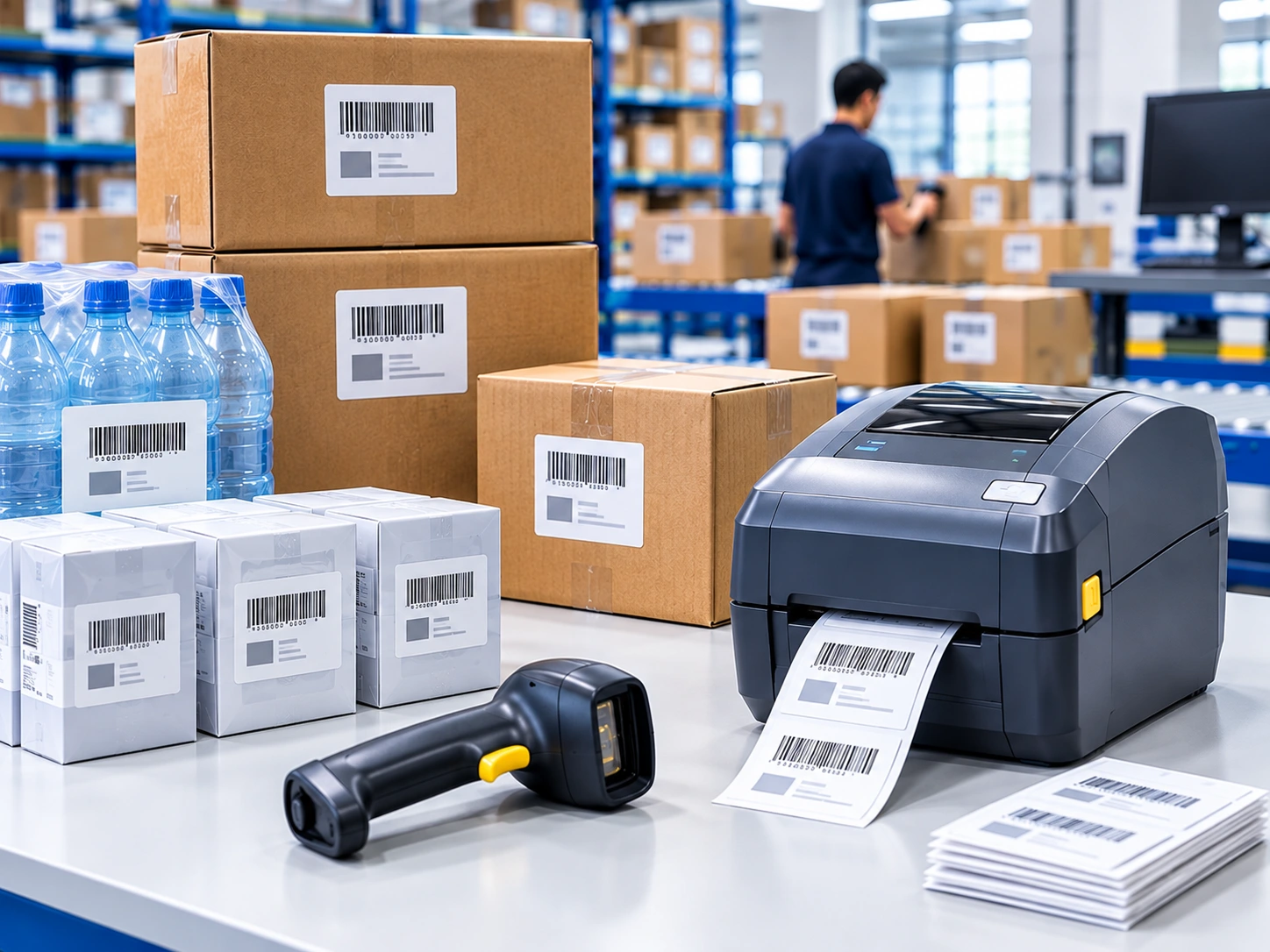
Effective labeling depends on selecting the right combination of printer, label material, printing method, and data format. Stallion Global helps businesses evaluate these requirements based on application conditions, printing volume, label life, and scanning needs.
Direct thermal printing is commonly used for applications where labels have a shorter operational life. Thermal transfer printing uses a ribbon to transfer ink onto the label material and is often selected when greater durability and resistance are required.
Factors such as print resolution, label dimensions, adhesive type, ribbon compatibility, surface characteristics, environmental exposure, and expected print volume should be considered when selecting a label printing system.
This application-focused approach helps businesses avoid choosing hardware based only on printer specifications and instead select a solution that fits the complete labeling workflow.
Request a Custom Product Labeling Solution Today
Product Labeling for Manufacturing and Supply Chain Operations
Manufacturing operations may require labels at several stages, including raw material identification, work-in-progress tracking, finished goods labeling, batch management, and shipment preparation.
In warehouses and distribution centers, barcode labeling supports receiving, put-away, picking, packing, stock verification, and dispatch. When integrated with a warehouse management system, scanned identification data can help maintain inventory accuracy and provide better operational visibility.
Retail businesses can use barcode and QR code labels for product identification, stock management, point-of-sale processes, and omnichannel fulfillment. Logistics operations can also use standardized labels to improve package identification and reduce errors during movement between locations.
Integrating Labels with AIDC Technology
Product labeling becomes more effective when it forms part of a broader AIDC strategy.
Barcode scanners, mobile computers, barcode printers, RFID systems, and software platforms can work together to connect physical products with digital records. For example, a warehouse operator can scan a product barcode using a mobile computer, retrieve information from the WMS, verify the item, and update its inventory status without manually entering the product code.
For applications requiring non-line-of-sight identification or bulk reading, RFID can complement traditional barcode identification. RFID tags and labels can provide another layer of automated identification for suitable inventory, asset-tracking, and supply chain applications.
This combination of identification, printing, scanning, and software integration can help organizations build more connected and scalable data-capture workflows.
How to Choose the Right Product Labeling Solution
There is no single label format or printing technology suitable for every business. The right approach depends on the product, operating environment, data requirements, scanning equipment, and expected label durability.
Businesses should evaluate:
- Label size, material, and adhesive
- Barcode or QR code requirements
- Required print resolution
- Printing volume and speed
- Direct thermal or thermal transfer technology
- Indoor or outdoor operating conditions
- Resistance to heat, moisture, abrasion, or chemicals
- Expected label lifespan
- Compatibility with scanners and mobile computers
- ERP, WMS, POS, or other software integration
- Future scalability and operational requirements
Stallion Global takes an application-led approach by considering the customer’s workflow and operating environment before recommending appropriate identification and printing technologies.
Why Choose Stallion Global?
With 30+ years of experience in AIDC and identification technologies, Stallion Global helps businesses implement practical solutions for barcode, RFID, printing, scanning, and mobile computing requirements.
Our expertise extends across industries such as manufacturing, warehousing, logistics, retail, healthcare, and distribution. Rather than treating labeling as an isolated printing requirement, our team evaluates how labels interact with scanners, mobile computers, software, inventory processes, and the wider supply chain.
Stallion Global works with established technology manufacturers, including Honeywell, Datalogic, Avery Dennison, and Impinj, giving customers access to proven technologies across different AIDC applications.
We support businesses across India and the Middle East, including projects and applications in markets such as the UAE, Oman, and Qatar. From understanding the identification requirement and selecting suitable hardware to supporting integration and deployment, our approach is focused on long-term operational value.
Our experience across diverse AIDC environments enables us to recommend solutions based on practical requirements such as scanning conditions, label durability, data volume, workflow, integration needs, and future scalability.
Improve Product Identification and Traceability
Reliable product identification requires more than a printed label. The right combination of label material, barcode technology, printing equipment, scanning devices, and software integration can create a dependable identification workflow.
Whether you need barcode labels for inventory, durable identification for manufacturing, QR-based product identification, or an integrated AIDC workflow, Stallion Global can help you evaluate the requirements and implement a solution aligned with your business operations.
Upgrade Your Labeling Workflow with Stallion Global
Frequently Asked Questions
What is product labeling used for?
Product labeling is used to identify products, SKUs, batches, serial numbers, inventory units, and other items throughout manufacturing, warehousing, retail, logistics, and distribution processes.
What information can be included on a product label?
A label can include product names, SKU numbers, 1D or 2D barcodes, QR codes, batch numbers, serial numbers, manufacturing dates, expiry dates, and other application-specific information.
Which printing technology is suitable for product labels?
The appropriate technology depends on the application. Direct thermal printing is suitable for many short-life labeling applications, while thermal transfer printing is generally preferred when labels require greater durability or resistance to environmental conditions.
How do barcode labels improve product traceability?
Barcode labels provide machine-readable product identification. When scanned and connected with ERP, WMS, POS, or inventory systems, they help businesses capture and associate product information throughout operational processes.